In suits at common law, where the value in controversy shall exceed twenty dollars, the right of trial by jury shall be preserved, and no fact tried by a jury shall be otherwise re-examined in any court of the United States than according to the rules of the common law.
Jury Preservation
...even with all its problems, the American judicial system both in its ideal theory and sometimes flawed practice offers persons accused of crimes more protection than any other system in the world.1
Even if this were true, it would only be so because Yahweh's2 judicial system is not operating anywhere in the world. Let me reiterate that "the right of a trial by jury" is a constitutional, not a Biblical, right. It is, in fact, adversarial to Yahweh's judicial system. (See Chapter 6 "Article 3: Judicial Usurpation," Chapter 14 "Amendment 5: Constitutional vs. Biblical Judicial Protection," and Chapter 15 "Amendment 6: Speedy Trials, Public Trials, and Impartial Juries" for additional information regarding the United States Constitutional Republic's unbiblical jury system as contrasted with Yahweh's judicial system.)
Common Law
Common Law - That which derives its force and authority from the universal consent and immemorial practice of the people. The system of jurisprudence that originates in England and which was latter [sic] adopted in the U.S. that is based on precedent instead of statutory laws.
Traditional law of an area or region; also known as case law. The law created by judges when deciding individual disputes or cases. The body of law which includes both the unwritten law of England and the statutes passed before the settlement of the United States.
In Old England there were two types of Courts - law and equity. In the law court the judge applied statutes. As time went on situations that were not covered by statutes were uncovered and Judges "created" law, usually in equity. This is "common law."
The U.S. is a common law country. In all states except Louisiana (which is based on the French civil code), the common law of England was adopted as the general law of the state, EXCEPT when a statute provides otherwise. Common law has no statutory basis; judges establish common law through written opinions that are binding on future decisions of lower courts in the same jurisdiction. Broad areas of law, most notably related to property, contracts and torts are traditionally part of the common law. These areas of law are mostly within the jurisdiction of the states and thus state courts are the primary source of common law. Thus, "common law" is used to fill in gaps. Common law changes over time, and at this time, each state has its own common law on many topics....3
Many Constitutionalists claim Christianity is intrinsic to common law. U.S. Supreme Court Justice Joseph Story, one of the fathers of American Jurisprudence, concurred:
One of the beautiful boasts of our municipal jurisprudence is, that Christianity is part of the common law.... There never has been a period, in which the common law did not recognize Christianity as lying at its foundations....4
Thomas Jefferson, however, renounced the idea that Christianity was intrinsic to common law:
For we know that the common law is that system of law which was introduced by the Saxons on their settlement in England, and altered from time to time by proper legislative authority from that time to the date of Magna Charta.... This settlement took place about the middle of the fifth century. But Christianity was not introduced till the seventh century; the conversion of the first Christian king of the Heptarchy having taken place about the year 598, and that of the last about 686. Here, then, was a space of two hundred years, during which the common law was in existence, and Christianity no part of it.5
Dennis Woods elaborates:
In England, natural law morphed into the "common law" of Henry II after the Norman Conquest of 1066 and bore only accidental resemblance to Biblical law. Henry II was no exemplar of Biblical law. His motivation was to create a law code common to the entire realm based on amalgamation of local custom. This he enforced in person as he or his judicial representatives traveled on horseback to outlying courts....
From that starting point common law became judge-made law based on precedent, not the Bible. Henry sought to impose his own common or customary law over that of the church, which culminated in the bloody conflict with Archbishop of Canterbury, Thomas Beckett.6
Unless Christianity was pronomian at the time the United States Constitution was ratified, it matters not if Christianity was part of the common law. The fact is the Christianity of that day was already far removed from Yahweh's law in government, as demonstrated by the complete absence of Biblical citations in the Constitutional Convention notes and the Federalist Papers. With few exceptions, Yahweh's law was abandoned in 1787. Late 18th-century Christianity was but a shell of 17th-century pronomian Puritanism. This was true even in The People v. Ruggles, in which Chancellor James Kent, Chief Justice of the Supreme Court of New York, testified to America's Christian roots while at the same time passing an unbiblical sentence:
The defendant was indicted ... for that he did ... wickedly, maliciously, and blasphemously utter and with a loud mouth publish in the presence and hearing of divers good and Christian people, of and concerning the Christian religion, and of and concerning Jesus Christ, the false, scandalous, malicious, wicked and blasphemous words following: "Jesus Christ was a bastard and his mother must be a whore," in contempt of the Christian religion.... [T]he defendant was tried and found guilty and was sentenced by the court to be imprisoned for three months and to pay a fine of $500.7
Enough morality had carried over from 17th-century Christendom that the New York Supreme Court ruled against blasphemy. But the Christianity that remained was not enough to induce the justices to condemn the blasphemer to death, as prescribed by early New England governments and by Yahweh Himself:
The legislators of Connecticut [in the 1650 Fundamental Agreement of the Colony of New Haven] begin with the penal laws, and ... they borrow their provisions from the text of Holy Writ. "Whosoever shall worship any other God than the Lord," says the preamble of the Code, "shall surely be put to death." This is followed by ten or twelve enactments of the same kind, copied verbatim from the books of Exodus, Leviticus, and Deuteronomy. Blasphemy, sorcery, adultery, and rape were punished with death....8
And he that blasphemeth the name of YHWH,9 he shall surely be put to death, and all the congregation shall certainly stone him: as well the stranger, as he that is born in the land.... (Leviticus 24:16, KJV)10
The death penalty (particularly in the form of stoning) would have been a violation of Amendment 8's prohibition against "cruel and unusual punishments." Justices Story, Kent, and others may have proclaimed Christianity to be a part of the common law, but, ultimately, the Constitution - not Yahweh's law - reigned supreme with them, as it did and continues to do in any case where the two are antithetical to each other.
In a review of John Whitehead's book The Second American Revolution, Dennis Woods points out another significant problem with common law:
In Appendix II, Whitehead upholds the Common Law and the principle of "stare decisis." Under "stare decisis" courts are bound to follow the precedent of previous cases.... The problem with stare decisis in the history of the Common Law is that there is a strong tendency for the precedent to quickly replace the authority of the higher law.... By the time of the American Revolution there were some 200 crimes punishable by the death penalty in Great Britain under Common Law, a radical departure from Biblical law. The law of God is subtly replaced by the law of man.11
The "rules of common law," as provided in Amendment 7, include the laws of Yahweh only insofar as they are consistent with the Constitution, congressional legislation, and the court's liking. Consequently, it is incumbent upon every true Christian12 to work toward replacing the common law with Yahweh's law.
Click Here to Read Chapter 17
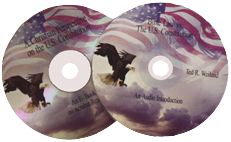
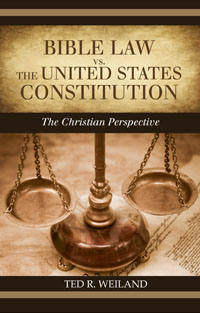
Click to order the Bible Law vs. The United States Constitution CDs:
- The e-book (on CD) A Christian Perspective on the U.S. Constitution
- The audio CD The Bible vs. The U.S. Constitution (Pts. 1 & 2)
End Notes
1. International Information Programs, USInfo.org, "Trial by Jury," Rights of the People: Individual Freedom and the Bill of Rights, http://usinfo.org/enus/government/overview/jury.html.
2. YHWH (most often pronounced Yahweh) is the English transliteration of the Tetragrammaton, the principal Hebrew name of the God of the Bible. For a more thorough explanation concerning the sacred names of God (without resorting to unscriptural extremes), "The Third Commandment" may be read online, or the book Thou shalt not take the name of YHWH thy God in vain may be ordered from Mission to Israel Ministries, PO Box 248, Scottsbluff, Nebraska 69363, for a suggested $4 donation.*
3. "The ‘Lectric Law Library's Lexicon on Common Law," http://www.lectlaw.com/def/c070.htm.
4. Joseph Story, The Miscellaneous Writings: Literary, Critical, Juridical, and Political of Joseph Story, LL.D. (Boston, MA: James Munroe and Company, 1835) p. 451.
5. Thomas Jefferson, Albert Ellery Burgh, ed., The Writings of Thomas Jefferson, 20 vols. (Washington, DC: The Thomas Jefferson Memorial Association, 1905) vol. 8, pp. 90-91, 97.
6. Dennis Oliver Wood, "Shape of America - The Declaration," http://www.america-betrayed-1787.com/shape-of-america-the-declaration.html.
7. The People v. Ruggles, 8 Johns 290 (1811).
8. Alexis de Tocqueville, Democracy in America, 2 vols. (New York, NY: The Colonial Press, 1899) vol. 1, pp. 36-37.
9. Where the Tetragrammaton (YHWH) - the four Hebrew characters that represent the personal name of God - has been unlawfully rendered the LORD or GOD in English translations, I have taken the liberty to correct this error by inserting YHWH where appropriate. For a more thorough explanation concerning the use of the names of God (without resorting to unscriptural extremes), "The Third Commandment" may be read online, or the book Thou shalt not take the name of YHWH thy God in vain may be ordered from Mission to Israel Ministries, PO Box 248, Scottsbluff, Nebraska, 69363, for a suggested $4 donation.*
10. All Scripture is quoted from the King James Version, unless otherwise noted. Portions of Scripture have been omitted for brevity. If you have questions regarding any passage, please study the text to ensure it has been properly used.
11. Dennis Oliver Woods, "A Review Of: The Second American Revolution," http://www.america-betrayed-1787.com/a-review-of-the-second-american-revolution.html.
12. Not everyone claiming to be a Christian has been properly instructed in the Biblical plan of salvation. Mark 16:15-16; Acts 2:36-41, 22:1-16; Romans 6:3-4; Galatians 3:26-27; Colossians 2:11-13; and 1 Peter 3:21 should be studied to understand what is required to be covered by the blood of Jesus and forgiven of your sins. For a more thorough explanation concerning baptism and its relationship to salvation, the book Baptism: All You Wanted to Know and More may be requested from Mission to Israel Ministries, PO Box 248, Scottsbluff, Nebraska 69363, for free.
*We are admonished in Matthew 10:8 "freely ye have received, freely give." Although we have a suggested a price for our books, we do not sell them. In keeping with 2 Corinthians 9:7, this ministry is supported by freewill offerings. If you cannot afford the suggested price, inform us of your situation, and we will be pleased to provide you with whatever you need for whatever you can send.
Click Here to Read Chapter 17