The enumeration in the Constitution of certain rights shall not be construed to deny or disparage others retained by the people.
Besides life, liberty, and the pursuit of happiness in the Declaration of Independence, the "other" rights were never specified:
The debates in both houses of Congress add little to the original understanding of the Ninth Amendment. The Senate conducted its sessions in secret, and the House debates failed to offer a glimmer as to what unenumerated rights are protected by the Ninth Amendment, how such rights might be identified, or by what branch of government they should be enforced.1
According to the Preamble, WE THE PEOPLE "establish[es] justice, ensure[s] domestic tranquility, provide[s] for the common defence, promote[s] the general welfare, and secure[s] the blessings of liberty" for the people and their posterity. According to the Declaration of Independence, WE THE PEOPLE secures these rights via a government that derives its "powers from the consent of the governed." Consequently, under constitutional government, the people themselves determine the unenumerated rights:
In 2000, Harvard historian Bernard Bailyn gave a speech at the White House on the subject of the Ninth Amendment. He said the Ninth Amendment refers to "a universe of rights, possessed by the people - latent rights, still to be evoked and enacted into law ... a reservoir of other, unenumerated rights that the people retain, which in time may be enacted into law."2
The Ninth Amendment is inclusive of all rights, at any given time, claimed or allowed by the people - oftentimes by a minority. These rights include natural rights, human rights, civil rights, political rights, and women's rights. They also include the right to murder your unborn child, the right to commit sodomy, and the right to openly worship and promote gods other than Yahweh.3 (Because violations of the First Commandment were legitimized by Amendment 1, the "right" to violate this Commandment is not unenumerated. The right to worship other gods than Yahweh has been specifically legalized by the First Amendment.) Anyone who thinks this list of "rights" misrepresents Amendment 9 needs to consider that the Ninth Amendment was employed in Roe v. Wade to legalize infanticide:
Justice William O. Douglas ... joined the majority opinion of the U.S. Supreme Court in Roe, which stated that a federally enforceable right to privacy, "whether it be founded in the Fourteenth Amendment's concept of personal liberty and restrictions upon state action, as we feel it is, or, as the District Court determined, in the Ninth Amendment's reservation of rights to the people, is broad enough to encompass a woman's decision whether or not to terminate her pregnancy."4
Former Assistant Attorney General Stephen J. Markman confirmed the unbiblical rights enumerated above are actually included in the Ninth Amendment:
...the Ninth Amendment constitutes a "license to constitutional decisionmakers [sic] to look beyond the substantive commands of the constitutional text to protect fundamental rights not expressed therein." Rights to abortion, contraception, homosexual behavior, and similar sexual privacy rights have already been imposed by judges detecting such rights in the Ninth Amendment.5
In Understanding the Constitution: Ten Things Every Christian Should Know About the Supreme Law of the Land, David Gibbs, Jr., and David Gibbs III argue for unalienable rights:
Our rights come from God, not from the state. Therefore, the state cannot take them away. What Uncle Sam gives, Uncle Sam can take away. But our nation's birth certificate, the Declaration of Independence makes clear that our rights are unalienable because they come from God.6
This sounds wonderful, but is it true? The State has certainly taken away an unwanted infant's right to life. The State has incrementally taken away gun owners' Second Amendment rights. The State has taken away the right to happiness, in particular the right to own property. Because rights come from the State, the State can take them away at its pleasure. On the other hand, as pointed out in Chapter 11, Yahweh's law does not recognize rights, God-given or otherwise, but only God-required responsibilities:
The biblical concept of justice has more to do with shaping and encouraging social duties in protecting the weak, the poor, the widows, and the orphans, than it does with asserting and protecting individual rights or liberties. In other words, the underlying jurisprudence of the Bible is more based on principles of duty than on concepts of rights.7
The theory of unalienable or natural rights can be traced back to the Age of Enlightenment. The term "natural rights," as employed by 18th-century men, is not compatible with the Bible. Deuteronomy 28 does not say we have a natural, human, or civil right to anything. Rather, we must serve Yahweh as God in order to receive His blessings:
And it shall come to pass, if thou shalt hearken diligently unto the voice of YHWH8 thy God, to observe and to do all his commandments which I command thee this day, that YHWH thy God will set thee on high above all nations of the earth: And all these blessings shall come on thee, and overtake thee, if thou shalt hearken unto the voice of YHWH thy God. (Deuteronomy 28:1-2)9
Instead of endowing us with rights, Yahweh expects righteousness from us. People who demand their rights are like children, focused only on themselves. People who pursue righteousness are focused on Yahweh and their fellow man. The former person promotes a government of, by, and for the people; the latter person promotes a government of, by, and for Yahweh. Rights without responsibilities amount to antinomian licentiousness, which Jude warned against:
Beloved, when I gave all diligence to write unto you of the common salvation, it was needful for me to write unto you, and exhort you that ye should earnestly contend for the faith which was once delivered unto the saints. For there are certain men crept in unawares, who were before of old ordained to this condemnation, ungodly men, turning the grace of our God into lasciviousness [licentiousness, NASB], and denying the only Lord God, and our Lord Jesus Christ. (Jude 1:3-4)
Licentiousness is the license to sin, and sin is a transgression of Yahweh's law (1 John 3:4). Consequently, Jude is describing antinomians who turn the grace of God into a license, or right, to break Yahweh's law. This is often the consequence of pursuing alleged rights instead of righteousness. The "rights" already mentioned, along with countless other legal immoralities, can be traced back to the United States Constitution. Had the framers provided for a government established upon Yahweh's moral laws, the constitutional "rights" claimed by so many people would be recognized and punished as the moral aberrations they are.
Demanding rights is an admission of slavery to the one from whom those rights are petitioned. Every United States citizen who looks to the Constitutional Republic to grant or recognize his rights acknowledges that the government is his sovereign:
The emphasis on human rights demands the rejection of Divine Revelation in favor of human legislation. Man thinks he is capable of legislating rights. Human legislation seeks to supplant God and make statutes in areas that only God can regulate. And the rule of iniquity is framed into law. The actual trade that is made in this deal is the exchange of true freedom for human bondage.... The end result is the rule of rights rather than the rule of law.10
Click Here to Read Chapter 19

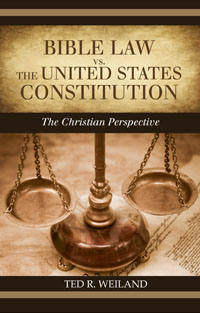
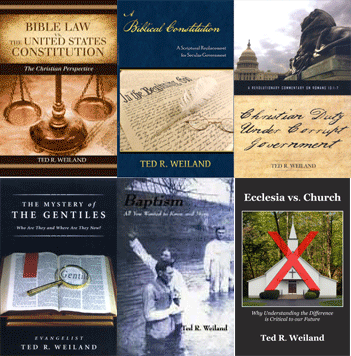
Click to order the Bible Law vs. The United States Constitution CDs:
- The e-book (on CD) A Christian Perspective on the U.S. Constitution
- The audio CD The Bible vs. The U.S. Constitution (Pts. 1 & 2)
1. "Ninth Amendment," The Free Dictionary, http://legal-dictionary.thefreedictionary.com/9th+Amendment.
2. Bernard Bailyn, Remarks at White House Millennium Evening, http://www.constitution.org/911/schol/pnur.htm, quoted in "Ninth Amendment to the United States Constitution," http://en.wikipedia.org/wiki/Ninth_Amendment_to_the_United_States_Constitution.
3. YHWH (most often pronounced Yahweh) is the English transliteration of the Tetragrammaton, the principal Hebrew name of the God of the Bible. For a more thorough explanation concerning the sacred names of God (without resorting to unscriptural extremes), "The Third Commandment" may be read online, or the book Thou shalt not take the name of YHWH thy God in vain may be ordered from Mission to Israel Ministries, PO Box 248, Scottsbluff, Nebraska 69363, for a suggested $4 donation.*
4. . Wade, 410 U.S. 113, quoted in "Ninth Amendment to the United States Constitution," http://en.wikipedia.org/wiki/Ninth_Amendment_to_the_United_States_Constitution.
5. Stephen J. Markman, "The Coming Constitutional Debate," Imprimis (Hillsdale, MI: Hillsdale College, 2010) vol. 39, num. 4, p. 5.
6. David Gibbs, Jr., David Gibbs III, Understanding the Constitution: Ten Things Every Christian Should Know About the Supreme Law of the Land (Seminole, FL: Christian Law Association, 2006) p. 21.
7. John W. Welch, "Biblical Law in America: Historical Perspectives and Potentials for Reform," 30 September 2002, http://www.contra-mundum.org/essays/theonomy/WEL1.pdf.
8. Where the Tetragrammaton (YHWH) - the four Hebrew characters that represent the personal name of God - has been unlawfully rendered the LORD or GOD in English translations, I have taken the liberty to correct this error by inserting YHWH where appropriate. For a more thorough explanation concerning the use of the names of God (without resorting to unscriptural extremes), "The Third Commandment" may be read online, or the book Thou shalt not take the name of YHWH thy God in vain may be ordered from Mission to Israel Ministries, PO Box 248, Scottsbluff, Nebraska, 69363, for a suggested $4 donation.*
9. All Scripture is quoted from the King James Version, unless otherwise noted. Portions of Scripture have been omitted for brevity. If you have questions regarding any passage, please study the Biblical text to ensure it has been properly used.
10. Dr. H. Rondel Rumburg, Foreword (21 February 1998) to Dr. Robert L. Dabney, Anti-Biblical Theories of Rights, which first appeared in the Presbyterian Quarterly, July 1888, (Hueytown, AL: Society for Biblical and Southern Studies, 1998) pp. 4-5.
*We are admonished in Matthew 10:8 "freely ye have received, freely give." Although we have a suggested a price for our books, we do not sell them. In keeping with 2 Corinthians 9:7, this ministry is supported by freewill offerings. If you cannot afford the suggested price, inform us of your situation, and we will be pleased to provide you with whatever you need for whatever you can send.
Click Here to Read Chapter 19