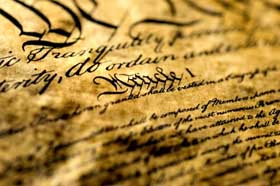
The ratification of the conventions of nine states, shall be sufficient for the establishment of this Constitution between the states so ratifying the same.
Done in convention by the unanimous consent of the states present, the seventeenth day of September, in the year of our Lord, one thousand seven hundred and eighty seven, and of the independence of the United States of America the twelfth in witness whereof we have hereunto subscribed our names.
Article 7 concludes the United States Constitution as originally proposed and attested to by forty signatories on September 17, 1787. It was ratified by the people of the States on June 21, 1788. The Preamble and Article 7 are two bookends to what President Abraham Lincoln described in his Gettysburg Address as a "government of the people, by the people, for the people," in opposition to a government of Yahweh,1 by Yahweh, and for Yahweh.
Christians2 are desperate to make the Constitution a Christian document. For example, consider how much Archie Jones read into the phrase "in the Year of our Lord," which dated the signatures of the thirty-nine state delegates and the Convention secretary:
...the plain implications of the reference ["in the year of our Lord"] are the same as those of the similar references in the Articles of Confederation (or anywhere else!): The Bible is true. Christ is the Savior. Christ, risen from the grave, ascended into heaven, and seated at the right hand of God the Father, is also the Lord, the sovereign Ruler of heaven and earth. The people of these United States are under the authority of Christ, whom they collectively acknowledge to be Lord. They have a special, covenantal relationship with Him, and that relationship, premised on His providential intervention in and rule of history, involves His blessings on the nation which has faith in Him and keep His commandments, and curses on the nation which collectively turns from faith in Him and so violates His holy laws. Hence, the nation must look to Him, and it and its civil governments must obey His laws.3
Moreover, since Christ's lordship is recognized in the Constitution, the American nation has a covenantal relationship to him. This covenantal relationship recognizes his lordship, his providential rule over history, his providential relationship to the American civil government and people.4
If what Jones claims is true, certainly somewhere in the Convention minutes, the copious Federalists Papers, or the constitutional framers' personal correspondence, one of them would have remarked that this was, in fact, their intent. Nothing Christian can be proven by the use of the term "in the year of our Lord" anymore than the declaration "God bless America," declared by so many politicians today, proves their Christianity. The only thing we know unequivocally about the use of "in the year of our Lord" is that it was a means of dating. Christians who were opposed to the Constitution during the ratification debates because it failed to mention God and Christianity were not reassured by the phrase "in the year of our Lord," and, in fact, the opposition knew better than to attempt to persuade them with such flimsy "evidence."
Even if each and every one of the signatories would have agreed with Jones, their rejection and replacement of Yahweh's laws with their own traditions eradicated any Christian implications. The phrase "in the year of our Lord" does not make the Constitution a Christian document, nor does it exonerate the framers of the sedition and treason against Yahweh found throughout the document. What proves the Constitution is not a Christian but a secular, humanistic contract are its "laws," not its terminology.
The test of lordship is not found in mere words, but instead in doing the will (the law - Psalm 40:8) of the Heavenly Father and fulfilling the words of His Son:
And why call ye me, Lord, Lord, and do not the things which I say? Whosoever cometh to me, and heareth my sayings, and doeth them, I will shew you to whom he is like: He is like a man which built an house, and digged deep, and laid the foundation on a rock: and when the flood arose, the stream beat vehemently upon that house, and could not shake it: for it was founded upon a rock. But he that heareth, and doeth not, is like a man that without a foundation built an house upon the earth; against which the stream did beat vehemently, and immediately it fell; and the ruin of that house was great. (Luke 6:46-49)5
Would Jones accept "in the year of our Lord" as a genuine profession of Christian faith from someone wanting to place membership in the church he attends? The previous Scripture demonstrates that such simple declarations, by themselves, mean nothing to Yahweh. Even if the framers intended this statement as an acknowledgment of the God of the Bible, Jesus6 declared that, if their works proved otherwise, He would still reject them. Christians are grasping at straws when they claim the statement "in the year of our Lord" makes what is otherwise unchristian Christian. That this is the best Christian Constitutionalists can come up with only further proves that the Constitution is, in fact, not Christian.
Click to order the Bible Law vs. The United States Constitution CDs:
- The e-book (on CD) A Christian Perspective on the U.S. Constitution
- The audio CD The Bible vs. The U.S. Constitution (Pts. 1 & 2)
1. YHWH (most often pronounced Yahweh) is the English transliteration of the Tetragrammaton, the principal Hebrew name of the God of the Bible. For a more thorough explanation concerning the sacred names of God, "The Third Commandment" may be read online, or the book Thou shalt not take the name of YHWH thy God in vain may be ordered from Mission to Israel Ministries, PO Box 248, Scottsbluff, Nebraska 69363, for a suggested $4 donation.*
2. Not everyone claiming to be a Christian has been properly instructed in the Biblical plan of salvation. Mark 16:15-16; Acts 2:36-41, 22:1-16; Romans 6:3-4; Galatians 3:26-27; Colossians 2:11-13; and 1 Peter 3:21 should be studied to understand what is required to be covered by the blood of Jesus and forgiven of your sins. For a more thorough explanation concerning baptism and its relationship to salvation, the book Baptism: All You Wanted to Know and More may be requested from Mission to Israel Ministries, PO Box 248, Scottsbluff, Nebraska 69363, for free.
3. Archie P. Jones, The Influence of Historic Christianity on Early America (Vallecito, CA: 1998) p. 66.
4. Archie P. Jones, "The Myth of Political Polytheism: A Review by Archie P. Jones," The Journal of Christian Reconstruction (Vallecito, CA: Chalcedon, 1996) p. 280.
5. All Scripture is quoted from the King James Version, unless otherwise noted. Portions of Scripture have been omitted for brevity. If you have questions regarding any passage, please study the text to ensure it has been properly used.
6. Yeshua is the English transliteration of our Savior's given Hebrew name, with which He introduced Himself to Paul in Acts 26:14-15. (Jesus is the English transliteration of the Greek Iesous, which is the Greek transliteration of the Hebrew Yeshua.) Because many people are unfamiliar or uncomfortable with Yeshua, I have chosen to use the more familiar Jesus in this book in order to remove what might otherwise be a stumbling block. For a more thorough explanation concerning the sacred names of God, "The Third Commandment" may be read online, or Thou shalt not take the name of YHWH thy God in vain may be ordered from Mission to Israel Ministries, PO Box 248, Scottsbluff, Nebraska 69363, for a suggested $4 donation.*