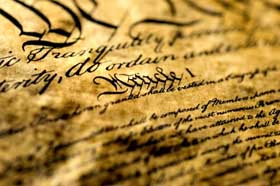
Excessive bail shall not be required, nor excessive fines imposed, nor cruel and unusual punishments inflicted.
Bail consists of property, usually money, pledged to the court as surety, or a guarantee, on behalf of a defendant, in order that he might be released from custody with the understanding that he will return for trial.
The Eighth Amendment to the U.S. Constitution requires that bail not be excessive. This means that bail should not be used to raise money for the government or to punish a person for being suspected of committing a crime. Remember: The purpose of bail is to allow the arrested person to remain free until convicted of a crime, and the amount of bail must be no more than is reasonably necessary to keep the suspect from fleeing before a case is over.1
Because posting bail cannot guarantee the defendant will not default on his promise to appear in court (commonly known as jumping bail), this constitutional allowance puts many criminals back on the streets. Even the defendants who do return to face charges often continue in their criminal activity while released on bail:
...only a very small percentage of criminals are ever convicted and sent to prison.... One case was cited of a man who was arrested for armed robbery and released on bond [bail]. During the next four months, while free on bond, he was arrested five times on various charges ranging from petty larceny to car theft. Finally he pleaded guilty to attempted petty theft and was again released to await sentencing.2
Amendment 8 bans excessive bail without defining what is excessive. Except for states in which bail schedules are preassigned, the definition of excessive is left to the arbitrary decisions of each judge. Congress passed the Judiciary Act of 1789 that specified which crimes bail could be applied to:
...upon all arrests in criminal cases, bail shall be admitted, except where the punishment may be death, in which cases it shall not be admitted but by the supreme or a circuit court, or by a justice of the supreme court, or a judge of a district court, who shall exercise their discretion therein, regarding the nature and circumstances of the offence, and of the evidence, and the usages of law.3
In 1966 and 1984, bail reform acts were passed:
In 1966, Congress enacted the Bail Reform Act of 1966 which states that a non-capital defendant is to be released, pending trial, on his personal recognizance or on personal bond, unless the judicial officer determines that such incentives will not adequately assure his appearance at trial. In that case, the judge must select an alternative from a list of conditions, such as restrictions on travel. Individuals charged with a capital crime, or who have been convicted and are awaiting sentencing or appeal, are to be released unless the judicial officer has reason to believe that no conditions will reasonably assure that the person will not flee or pose a danger. In non-capital cases, the Act does not permit a judge to consider a suspect's danger to the community, only in capital cases or after conviction is the judge authorized to do so.
The 1966 Act was particularly criticized within the District of Columbia, where all crimes formerly fell under Federal bail law. In a number of instances, persons accused of violent crimes committed additional crimes when released on their personal recognizance. These individuals were often released yet again....
In 1984 Congress replaced the Bail Reform Act of 1966 with new bail law.... The main innovation of the new law is that it allows pre-trial detention of individuals based upon their danger to the community; under prior law and traditional bail statutes in the U.S., pre-trial detention was to be based solely upon the risk of flight.
18 USC 3142(f) provides that only persons who fit into certain categories are subject to detention without bail: persons charged with a crime of violence, an offense for which the maximum sentence is life imprisonment or death, certain drug offenses for which the maximum offense is greater than 10 years, repeat felony offenders, or if the defendant poses a serious risk of flight, obstruction of justice, or witness tampering. There is a special hearing held to determine whether the defendant fits within these categories; anyone not within them must be admitted to bail.4
The contradiction between the Sixth Amendment's provision for speedy trials and the Eighth Amendment's provision for bail when a speedy trial is unlikely is another inherent flaw in the United States Constitution. When government is based upon Yahweh's5 law, trials and punishment are meted out swiftly, if not immediately, and bail (like prison) is superfluous.
The only downside to Yahweh's no-bail system is that innocent men will occasionally incur short-term incarcerations while awaiting trial. Better a few innocent men suffer temporary incarceration than many victims suffer at the hand of criminals freed on bail.
The Bible warns against becoming surety for another person, which rules out providing bail for others:
He that is surety for a stranger shall smart for it: and he that hateth suretiship is sure [safe, NASB]. (Proverbs 11:15)6
A man void of understanding striketh hands, and becometh surety in the presence of his friend. (Proverbs 17:18)
Becoming surety demands that a person guarantee the future of another person, a presumption the Bible identifies as arrogance:
Boast not thyself of to morrow; for thou knowest not what a day may bring forth. (Proverbs 27:1)
Providing bail is worse because it vainly attempts to guarantee another man's integrity.
The Eighth Amendment prohibits excessive fines, again, without defining what is excessive. Non-excessive fines sound like a good idea, except they are unbiblical, particularly when paid to the State:
Fines, which are paid to the state for law violations, are pagan forms of revenue collecting and punishment. They are not Biblical. They are not because they pervert judgment and stem from a pagan view of man. They pervert judgment because the state will put more effort into the enforcement of those laws that bring the greatest amount of revenues to the state coffers than those that do not.7
Leviticus 5 and Numbers 5 provide the only Biblical examples similar to State fines:
If a soul commit a trespass, and sin through ignorance, in the holy things [tithes, offerings, etc.; 2 Chronicles 31:6] of YHWH;8 then he shall bring for his trespass unto YHWH a ram without blemish out of the flocks, with thy estimation by shekels of silver, after the shekel of the sanctuary, for a trespass offering: And he shall make amends for the harm that he hath done in the holy thing, and shall add the fifth part thereto, and give it unto the priest.... (Leviticus 5:15-16)
...When a man or woman shall commit any sin that men commit, to do a trespass against YHWH, and that person be guilty; then they shall confess their sin which they have done: and he shall recompense his trespass with the principal thereof, and add unto it the fifth part thereof, and give it unto him against whom he hath trespassed. But if the man have no kinsman to recompense the trespass unto, let the trespass be recompensed unto YHWH, even to the priest.... (Numbers 5:5-8)
In both instances - in Leviticus 5, in which a twenty percent additional penalty is levied, and in Numbers 5, in which restitution is required when there are no victims or relatives alive to receive restitution - the "fines" are to be paid to the priests (or, under the New Covenant, to full-time kingdom laborers). Except for those two instances, additional fines or penalties always go to the victim or the victim's relatives. Biblical "fines" paid to the victims of non-capital crimes (a practice rarely witnessed in American jurisprudence), are of an amount many constitutional judges would consider excessive, particularly with the indentured servitude proviso for anyone unable to pay restitution and additional penalties. Yahweh's law requires two to five times restitution on things stolen, depending upon the nature of the crime:
If a man shall steal an ox, or a sheep, and kill it, or sell it; he shall restore five oxen for an ox, and four sheep for a sheep. (Exodus 22:1)
An ox's lower rate of reproduction was probably one reason oxen were more highly valued. Also, it takes longer to bring oxen to maturity than it does sheep, and sheep do not require training. Both sheep and oxen were eaten and used for clothing, but only oxen were used to till the land and pull carts. Oxen were the tractors in Moses' day. Given a choice between losing a sheep or a tractor, a prudent husbandman would choose the former. Steal a man's sheep and he would lose a hide and some meat. Steal a man's ox - his means of livelihood - and his family's survival could be jeopardized. Theft of a man's sheep represents only an immediate loss. Theft of a man's ox represents a future loss as well.
Exodus 22:1 is case law that provides precedent against much more than just the theft of livestock. For example, if a thief steals a tractor from a farmer, he should be required to pay the equivalent of five tractors, whereas a car thief should pay the equivalent of four cars. This is true because the tractor is a farmer's means of livelihood, while the car is only a means of transportation. If, instead, the victim were a traveling salesman, who owns and uses a tractor only for property maintenance, the judgment would be transposed. Purpose, not price, determines an object's worth and the rate of restitution. Yahweh's standard penalty rates eliminate arbitrary decisions common among judges and juries alike. They also eliminate both excessive and deficient judgments.
If the theft be certainly found in his hand alive, whether it be ox, or ass, or sheep; he shall restore double. (Exodus 22:4)
In cases in which the thief is apprehended with the stolen item still in his possession, the stolen item is restored to the owner and he is further compensated with the current value of what was stolen. This additional remuneration covers any loss or inconvenience incurred while the stolen item is not in the owner's possession. Of equal importance, it punishes the thief and deters him from further criminal activity.
A man apprehended with the stolen item in his possession might be someone who stole out of necessity, in contrast to a career thief who steals for profit. Solomon addressed the former type of thief:
Men do not despise a thief, if he steal to satisfy his soul when he is hungry; but if he be found, he shall restore sevenfold; he shall give all the substance of his house. (Proverbs 6:30-31)
Because Yahweh's law makes no mention of a sevenfold reparation, this should not be taken literally. The number seven in the Bible is often used to signify perfection, completion, and fullness. A thief of necessity, although he may be pitied, must still pay what the law requires, even if it results in bankruptcy and indentureship:
...if he have nothing [with which to pay the required restitution], then he shall be sold for his theft. (Exodus 22:3)
A thief is indentured until he has paid the required two-, four-, or five-fold restitution to either his victim or to the purchaser of his indentured service. In some high-dollar cases, such as in the Bernie Madoff9 scam, thieves would not be sent to prison to be housed, fed, and entertained at taxpayer's expense. Instead, they would be consigned to perpetual servitude. Any proceeds from that servitude would be divided among their victims. Restitution and indentureship would eliminate any need for prisons, and the deterrent effect would considerably reduce theft in society.
Under Yahweh's law, the person at fault is responsible for damages - not an insurance company. Insurance companies contribute to irresponsibility and lawlessness by sheltering people from paying for the full consequences of their actions:
The failure of a society to ground itself on restitution, or its departure from this principle, means a growing necessity for costly protection by means of insurance. Much insurance is, all too often, a form of self-restitution, in that the buyer pays for protection against irresponsible people who will not make restitution. The large insurance premiums paid by responsible persons and corporations are their self-protection against the failure of the law to require restitution.10
What should be done with a thief who refuses to pay restitution? As contempt of court, or more properly, contempt of Yahweh and His law, such a refusal would be a capital crime:
And thou shalt come unto ... the judge that shall be in those days, and inquire; and they shall shew thee the sentence of judgment: And thou shalt ... observe to do according to all that they inform thee: ...thou shalt not decline from the sentence which they shall shew thee, to the right hand, nor to the left. And the man that will do presumptuously, and will not hearken unto ... the judge, even that man shall die: and thou shalt put away the evil from Israel. And all the people shall hear, and fear, and do no more presumptuously. (Deuteronomy 17:9-13)
When given the choice to pay restitution, be indentured, or die, a thief will choose to pay restitution or be indentured, and it is unlikely he will ever steal again.
Under Yahweh's law, only the victim is compensated; the "State" does not receive any remuneration whatsoever, except for present-day instances of Leviticus 5:15-16 and Numbers 5:5-8. Under America's constitutional form of government, the victim often receives little or no compensation and is further victimized by the very system that is supposed to protect him. The State slaps the thief's hand and collects its fines. If the offender repeats his crime, the State may sentence him to prison, which is funded by the victim's tax dollars:
"The guilty man lodged, fed, clothed, warmed, lighted, entertained, at the expense of the State in a model cell, issued from it with a sum of money lawfully earned, has paid his debt to society; he can set his victims at defiance; but the victim has his consolation; he can think that by taxes he pays to the Treasury, he has contributed towards the paternal care, which has guarded the criminal during his stay in prison." These were the bitter and sarcastic words of Prins, the Belgian, at the Paris Prison Congress in 1895, when during a discussion of the problem of restitution to victims of crime, he could no longer contain his indignation at various practical and theoretical difficulties raised against his proposals on behalf of the victim.11
The offended party is preyed upon first by a low-class thief and then by a high-class thief.
Under modern law, fines are almost invariably paid to the city, county or federal government. If the victim wants any remedy he must sue for damages in a civil court. However, as everyone knows, by the time a criminal has paid his fines to the court, he is usually depleted of funds or consigned to prison where he is earning nothing and therefore could not pay damages even if his victim went to the expense of filing a suit and getting a judgment. As a result, modern justice penalizes the offender, but does virtually nothing for the victim.12
The United States Constitutional Republic's criminal justice system penalizes the victim and other innocent people by taxing them to pay for the imprisonment of convicted thieves.
Fines paid to the city, county, or state, or a prison term for the criminal, does nothing for the victim and very little for the offender. Neither do those sentences often fit the crime. Actually a term in prison, or in jail, cannot even be considered punishment. It is rather a REWARD to the criminal for his crime. He is relieved of the responsibility of providing his own shelter, clothing, food, and medical care. He is given total economic security at the expense of the law-abiding citizens, including his victims.13
When Yahweh's judgments are enforced, the tax-subsidized prison system becomes superfluous. A portion of today's prison population who were unjustifiably convicted of non-Biblical crimes created by the State would be set free. Capital criminals would be executed.14 Thieves would be released to either pay restitution to their victims or work off their debt in indentured servitude.15 (See Chapter 22 "Amendment 13: Constitutional vs. Biblical Slavery" for additional information regarding indentureship versus incarceration.) The argument that all prisoners incarcerated by the Constitutional Republic would have to be released (based upon the idea that people cannot be prosecuted ex post facto) does not stand up because Yahweh's law is eternal and has always been in effect.
Yahweh's law does not allow the State to levy additional fines or penalties, as is done, for example, in most motor vehicle accidents. Unlike man's edicts against speeding, carrying a concealed weapon without a permit, possessing firearms made illegal by the State, and innumerable other victimless "crimes," no one is liable under Yahweh's law unless he has caused damage or injury to someone else.
When early American law more closely resembled Yahweh's law, they required a crime be committed, which in turn required a damaged party. This law, known as corpus dilecti, is perverted in countless present-day cases in which the State declares itself the damaged party and incarcerates or imposes fines upon people who have not caused damage or injury to anyone.
Amendment 8's prohibition against cruel and unusual punishments implies the Constitutional Republic's punishments must be kind and usual. The Constitution's failure to define "cruel and unusual" allows unbiblical and antinomian courts to arbitrarily determine what is allowable.
According to the Bible, capital punishment for capital crimes is justifiable.16 Former Florida Attorney General Robert L. Shevin succinctly presented the case for capital punishment:
The human capacity for good and for compassion makes the death penalty tragic; the human capacity for evil and depraved behavior makes the death penalty necessary.17
The constitutional framers disagreed upon what comprised cruel and unusual punishment. Some of them believed capital punishment itself was cruel and unusual:
There were some significant voices at the time in favor of abolishing capital punishment. Some argued that the success of the new republic should depend upon the virtue of its citizens and not on their fear of a harsh penal code, which many saw as the hallmark of tyranny. Benjamin Rush, one of the signers of the Declaration of Independence, declared that "capital punishments are the natural offspring of monarchical governments." Even a conservative like Alexander Hamilton believed that "the idea of cruelty inspires disgust," and that the death penalty undermined republican values and behavior.18
The virtue of capital punishment was settled by Yahweh in His law long ago, but the debate over the death penalty rages on, thanks, in part, to the ambiguity of Amendment 8's wording:
In a totally unexpected opinion in June 1972, a closely divided Supreme Court vacated the death sentences of approximately 600 inmates in prisons across the country. In Furman v. Georgia, the majority held that imposition of the then existing capital punishment schemes violated the ban on cruel and unusual punishment. ...[The Court ruled] that the legal methods by which it was applied were irrational and arbitrary and as such, violated the Eighth Amendment.19
As of 2012, fifteen states have repealed the death penalty. The Supreme Court's capriciousness regarding "cruel and unusual punishments" is witnessed by its varied and often contradictory decisions. Consider the following sampling:
- Wilkerson v. Utah, 99 U.S. 130 (1878): Death by firing squad was ruled not to be cruel and unusual punishment under the Eighth Amendment. Other methods of torture such as "drawing and quartering, embowlling [sic] alive, beheading, public dissection, and burying alive" were forbidden.
- Weems v. U.S., 217 U.S. 349 (1910): The Court held that cruel and unusual punishment should not be confined to the "forms of evil" that the framers of the Bill of Rights had witnessed, rendering "cruel and unusual" subject to changing interpretations.
- Louisiana ex rel. Francis v. Resweber, 329 U.S. 459 (1947): The Court ruled that "the cruelty against which the Constitution protects a convicted man is cruelty inherent in the method of punishment, not the necessary suffering involved in any method employed to extinguish life humanely."
- Coker v. Georgia, 433 U.S. 584 (1977): The death penalty was ruled unconstitutionally excessive for the rape of a woman and, by implication, for any crime where a death does not occur.
- Rummel v. Estelle, 445 U.S. 263 (1980): The life sentence was upheld, with the possibility of parole for fraud crimes totaling $230.
- Harmelin v. Michigan, 501 U.S. 957 (1991): A life sentence was upheld, without the possibility of parole, for possession of 672 grams of cocaine.
- Lockyer v. Andrade, 538 U.S. 63 (2003): A fifty-years-to-life sentence was upheld, with the possibility of parole imposed under California's three-strikes law, when the defendant was convicted of shoplifting videotapes worth a total of about $150.
- Kennedy v. Louisiana, 554 U.S. (2008): The ruling of Coker v. Georgia (that the death penalty was unconstitutionally excessive for rape of a woman) was extended to include the rape of a child.
These are but a few examples of a government of, by, and for a fickle people and adjudicated by a mercurial court system.
...public perceptions of standards of decency with respect to criminal sanctions are not conclusive. A penalty must also accord with "the dignity of man," which is the basic concept underlying the Eighth Amendment....Gregg v. Georgia (1976)20
We have nothing to guide us in defining what is cruel and unusual apart from our own consciences. A punishment which is considered fair today may be considered cruel tomorrow. And so we are not dealing with a set of absolutes. Our decision must necessarily spring from the mosaic of our beliefs, our backgrounds and the degree of our faith in the dignity of the human personality.Supreme Court Justice Frank Murphey21
What we find described above is government ruled by the prevailing humanism of the day. Friedrich W. Nietzsche (1844-1900) said, " [the criminal's] punishment ... is meted out in accordance with precisely the degree of astonishment the latter [judges] feel when they regard the incomprehensible nature of his deed."22 In Trop v. Dulles, Supreme Court Chief Justice Earl Warren wrote, "The [Eighth] Amendment must draw its meaning from the evolving standards of decency that mark the progress of a maturing society."23 Because man's standards - including the Constitution - are "not conclusive," they lead to confusion and contradiction. Yahweh's standards are the polar opposite of man's: they are unchanging, authoritative, trustworthy, and, above all, just.
In Roper v. Simmons (2005), the Supreme Court ruled that the death penalty for anyone under the age of eighteen violated the Eighth Amendment's ban on "cruel and unusual punishments," and in Atkins v. Virginia (2002), the Court held that it would be cruel and unusual to execute anyone mentally disabled. As a result, insanity pleas have become an all too common means for criminals to elude capital punishment.
Unlike current constitutional law, Yahweh's law allows no exceptions for the prescribed punishment of convicted murderers. Leviticus 24:17 dictates the judgment for intentional, premeditated murder is death. Human life is so valuable to Yahweh that any man (or animal) that maliciously takes another person's life is to be put to death. Death penalty opponents find this incongruous. They believe life is so valuable it must be protected at all costs. However, the anti-capital punishment advocates are the ones who cheapen life. For example, if a murderer is given twenty years in prison instead of being put to death, the life of the victim has been assigned a value of only twenty years. The life of a murderer is certainly not more valuable than the life of the person he murdered. Put another way, the life of the person murdered is so valuable it requires the life of the murderer:
...surely your blood of your lives will I require; at the hand of every beast will I require it, and at the hand of man; at the hand of every man's brother will I require the life of man. Whoso sheddeth man's blood, by man shall his blood be shed: for in the image of God made he man. (Genesis 9:5-6)
Premeditated murder is the one crime for which Yahweh offers no clemency:
...ye shall take no satisfaction [restitution] for the life of a murderer, which is guilty of death: but he shall be surely put to death. And ye shall take no satisfaction for him [the convicted murderer].... So ye shall not pollute the land wherein ye are: for blood it defileth the land: and the land cannot be cleansed of the blood that is shed therein, but by the blood of him that shed it. (Numbers 35:31-33)
Yahweh's law allows monetary compensation for cases other than first-degree murder. However, this is at the discretion of the blood avenger:
If an ox gore a man or a woman, that they die: then the ox shall be surely stoned, and his flesh shall not be eaten; but the owner of the ox shall be quit [go unpunished, NASB]. But if the ox were wont to push with his horn in time past [in the habit of goring, NASB], and it hath been testified to his owner, and he hath not kept him in, but that he hath killed a man or a woman; the ox shall be stoned, and his owner also shall be put to death. If there be laid on him a sum of money, then he shall give for the ransom of his life whatsoever is laid upon him.... (Exodus 21:28-30)
Biblical instruction and the opportunity for repentance should always precede execution. Execution sermons were common during the Colonial period for this very purpose and as a means of warning the attending community against similar crimes. The Apostle Paul wrote about people who had committed capital felonies and had gone on to become a part of the Christian community:
Know ye not that the unrighteous shall not inherit the kingdom of God? Be not deceived: neither fornicators, nor idolaters, nor adulterers, nor effeminate, nor abusers of themselves with mankind [sodomites], nor thieves, nor covetous, nor drunkards, nor revilers, nor extortioners, shall inherit the kingdom of God. And such were some of you: but ye are washed, but ye are sanctified, but ye are justified in the name of the Lord Jesus and by the Spirit of our God. (1 Corinthians 6:9-11)
Judges, victims, and the victims' next-of-kin may consider repentance and conversion as extenuating factors when determining whether criminals should be put to death for capital crimes - except in cases of murder. Yahweh's law demands murderers must be executed:
...if a man come presumptuously upon his neighbour, to slay him with guile; thou shalt take him from mine altar, that he may die. (Exodus 21:14)
In 1 Kings 1:50-53, King Solomon spared Adonijah's life for his crime of conspiracy when Adonijah took hold of the horns of the altar in the tabernacle. But when the murderer Joab took the same desperate measure in 1 Kings 2:28-34, Solomon refused to spare his life. This no-clemency clause of the Sixth Commandment, which is attached only to the judgment for murderers, demonstrates how grievous murder is to Yahweh.
Instead of making His punishments as humane as possible, Yahweh chose cruel and unusual forms of punishments. Stoning, His principal means of carrying out public executions,24 certainly does not meet Supreme Court Justice William Brennan's criteria (Numbers 1 and 3) in Furman v. Georgia (1972):
There are, then, four principles by which we may determine whether a particular punishment is "cruel and unusual." [1] ...a punishment must not, by its severity, be degrading to human dignity.... [2] It is unlikely that this Court will confront a severe punishment that is obviously inflicted in wholly arbitrary fashion; no State would engage in a reign of blind terror. [3] Nor is it likely that this Court will be called upon to review a severe punishment that is clearly and totally rejected throughout society; no legislature would be able even to authorize the infliction of such a punishment. [4] Nor, finally, is it likely that this Court will have to consider a severe punishment that is patently unnecessary; no State today would inflict a severe punishment knowing that there was no reason whatever for doing so. In short, we are unlikely to have occasion to determine that a punishment is fatally offensive under any one principle.25
If we believe Yahweh unquestionably just, we must embrace His means of punishment and renounce the Eighth Amendment as rebellion against Him. Because He is a loving and merciful God, who desires no one to perish and everyone to come to repentance, His judgments are not only just but also remedial and preventative:
And thou shalt stone him [a promoter of false gods] with stones, that he die; because he hath sought to thrust thee away from YHWH thy God.... And all Israel shall hear, and fear, and shall do no more any such wickedness as this is among you. (Deuteronomy 13:10-11)26
People who identify themselves as "New Testament Christians"27 play right into the hands of the anti-capital punishment establishment. Such Christians make a distinction between the "God of the Old Testament" and the "God of the New Testament." They believe the God of the Old Testament was cruel, vengeful, and unsympathetic, whereas the God of the New Testament is loving, merciful, and gracious. Are there two Gods in the Bible?
...I am YHWH I change not.... (Malachi 3:6)
...the Father ... with whom is no variableness, neither shadow of turning. (James 1:17)
Consider also the following Old Testament descriptions of Yahweh:
...YHWH God, merciful and gracious, longsuffering, and abundant in goodness and truth. (Exodus 34:6)
O give thanks unto YHWH; for he is good; for his mercy endureth for ever. (1 Chronicles 16:34)
...thou art a God ready to pardon, gracious and merciful, slow to anger, and of great kindness.... (Nehemiah 9:17)
Have I any pleasure at all that the wicked should die? saith the Lord YHWH: and not that he should return from his ways, and live?... For I have no pleasure in the death of him that dieth, saith the Lord YHWH: wherefore turn yourselves, and live ye. (Ezekiel 18:23, 32)
Whether viewed from the Old or the New Testament perspective, Yahweh is a God of love, grace, and mercy. Capital punishment conceived by a loving and merciful God cannot be barbaric. Yahweh instituted stoning as a deterrent to criminal behavior:
The death penalty ... provides a deterrence effect - deterring the criminal from future crime (he dies), deterring other criminals from committing similar crimes (fear of death), and deterring God from bringing His covenant judgments on the community for its failure to uphold covenant law (fear of God's wrath).28
Consider the following compelling statistics:
Of all the men currently in prison ... how many of these men had been tried and convicted of murder, had been released, and then had killed again? The number ran to more than eight hundred.... Five of these killers had not been released, but had killed prison guards. Whatever our academic arguments about deterrence and the death penalty, here is something we have to deal with. There are eight hundred citizens and five prison guards who would still be alive today if these killers had been quickly dispatched.29
Some people reject capital punishment as vengeful. It is, indeed, vengeful. But instead of personal vengeance, it is vengeance at the hands of Yahweh by way of His judicial protocol. As such, capital punishment helps contain vigilantism and generational feuds. The Supreme Court's first Chief Justice John Jay concurred:
Retaliation is also manifest in the punishment prescribed for murder - life for life. Legal punishments are adjusted and inflicted by the law and magistrate, and not by unauthorized individuals.... It certainly was not the design of the law or ordinance in question, to encourage a spirit of personal or private revenge.31
People who quote Romans 12:19 as a proof text against capital punishment need to read further:
Dearly beloved, avenge not yourselves, but rather give place unto wrath: for it is written, Vengeance is mine; I will repay, saith the Lord. Therefore if thine enemy hunger, feed him; if he thirst, give him drink: for in so doing thou shalt heap coals of fire on his head. Be not overcome of evil, but overcome evil with good. Let every soul be subject unto the higher powers. For there is no power but of God: the powers that be are ordained of God. Whosoever therefore resisteth the power, resisteth the ordinance of God: and they that resist shall receive to themselves damnation. For rulers are not a terror to good works, but to the evil. Wilt thou then not be afraid of the power? Do that which is good, and thou shalt have praise of the same: For he is the minister of God to thee for good. But if thou do that which is evil, be afraid; for he beareth not the sword in vain: for he is the minister of God, a revenger to execute wrath upon him that doeth evil. (Romans 12:19-13:4)
The injunction against personal vengeance does not eliminate capital punishment. Rather, capital punishment eliminates personal vengeance:
The New Testament commands us to love of our enemies (Matthew 5:44), to not take "an eye for an eye and a tooth for a tooth" (Mt. 5:38) and to not avenge ourselves since vengeance belongs to the Lord (Rom. 12:19). ...if we were to apply such passages and reasoning to the state, it would rule out ... any other penalties too.... The truth of the matter is that these Scriptures were given to prevent private citizens from taking vengeance into their own hands.31
The vengeance of Yahweh is something in which to rejoice:
The righteous shall rejoice when he seeth the vengeance: he shall wash his feet in the blood of the wicked. So that a man shall say, Verily there is a reward for the righteous: verily he is a God that judgeth in the earth. (Psalm 58:10-11)
This is not an endorsement for unscriptural vigilantism; Biblical judicial protocol must be followed.32
Opponents of the death penalty believe any form of capital punishment is inhumane, and even the champions of capital punishment are always seeking a more humane means of execution. They claim to be motivated by mercy and compassion. Mercy and compassion for whom? Certainly not for the victims, the victims' next of kin, society, or latent criminals. Who does this leave except the convicted criminals? Unrepentant murderers, rapists, and other capital felons do not deserve our compassion and mercy. To show mercy to such criminals implies we believe we are more virtuous than Yahweh. Although death penalty opponents see themselves as merciful and kind, in truth they are cruel to everyone but the criminal. In Proverbs 12:10, Solomon wrote, "the tender mercies of the wicked are cruel."
Christians today are afraid of the laws of the Bible. They are actually embarrassed by them. They do not recognize that biblical law is a two-edged sword of God's judgment: blessing for the righteous, but cursing for the unrighteous (Romans 13:1-7). They do not understand that God's law-order for society is merciful. For example, God requires the death penalty for kidnappers (Ex. 21:16). The death penalty used to be imposed on kidnappers in the United States, and kidnapping was rare. It is no longer imposed regularly, and kidnapping has become a blight. Kidnapping by terrorists in Europe is commonplace. Who says that God's law regarding kidnapping is too harsh? Harsher than kidnapping itself? So it is with all of God's civil laws [and their judgments]. They are merciful compared with the effects of unpunished evil. The modern world is learning just how unmerciful a society can be that is not governed by biblical law.33
Some people's "sense of decency" pits them against Yahweh's righteous judgments. Anyone who prefers to show mercy to a convicted criminal, rather than assuring greater public safety, is only concerned about protecting his own sensibilities and making himself feel good. The purpose of capital punishment is to remove the criminal from society and cleanse the community of evil, which, in turn, provides for peace and security and a well-ordered society. Fewer criminals and fewer victims are the obvious benefits of such a policy.
In order for the death penalty to be the greatest possible deterrent, Yahweh chose a brutal form of execution. The harsher the punishment, the greater the deterrent. People are less likely to write checks against insufficient funds when they are penalized thirty dollars rather than thirty cents. Likewise, people are less likely to commit felonies when the maximum penalty is mandatory for unrepentant criminals. This is especially true if it is compulsory for the whole community to attend and participate in public executions:
And YHWH spake unto Moses, saying, Bring forth him that hath cursed without the camp; and let all that heard him lay their hands upon his head, and let all the congregation [community] stone him.... And he that blasphemeth the name of YHWH, he shall surely be put to death, and all the congregation shall certainly stone him: as well the stranger, as he that is born in the land.... (Leviticus 24:13-16)
Stoning is one of the few methods of capital punishment that allows direct involvement by the witnesses and others. Witnesses must be so certain of their testimony that they, along with the blood avengers, are prepared to initiate judgment. Yahweh did not prescribe lynchings,34 decapitations, gassings, electrocutions, or lethal injections because they do not allow for the blood avenger, or next of kin, the witnesses, and others in the community to be involved:
But if any man hate his neighbour, and lie in wait for him, and rise up against him, and smite him mortally that he die, and fleeth into one of these cities [of refuge]: Then the elders of his city shall send and fetch him thence, and deliver him into the hand of the avenger of blood, that he may die. (Deuteronomy 19:11-12)
At the mouth of two witnesses, or three witnesses, shall he that is worthy of death be put to death; but at the mouth of one witness he shall not be put to death. The hands of the witnesses shall be first upon him to put him to death, and afterward the hands of all the people. So thou shalt put the evil away from among you. (Deuteronomy 17:6-7)
This mandatory provision for direct participation by the witnesses assures more certain testimony. Exodus 19:13 also allows the criminal to be shot. This is probably because firing squads (whether using bows or rifles) also allow witnesses and others to participate. Firing squads could be used as a substitute when stones are unavailable. In non-capital cases, flogging can be prescribed as punishment (Deuteronomy 25:1-3), which also provides a means for the witnesses to be involved in meting out judgment.
It is sometimes argued that Yahweh ordained stoning because poison gas, lethal injection, and electrocution were not available. However, lynching, decapitation, or spearing, which would all have been swifter and more merciful than stoning, could have been prescribed by Yahweh at that time but were not. Yahweh desired capital punishment to have the greatest possible impact upon society. This can only be accomplished when the whole community is involved in the execution, which is achieved with stoning or a firing squad.
Stoning offers an additional enduring deterrent effect:
And Joshua, and all Israel with him, took Achan ... and all that he had: and they brought them unto the valley of Achor.... And all Israel stoned him with stones, and burned them with fire, after they had stoned them with stones. And they raised over him a great heap of stones unto this day.... (Joshua 7:24-26)
These heaps of stones testify to succeeding generations of the futility of a wicked lifestyle. When a young person asked his father, "What is this pile of stones?," the father would have the opportunity to caution his child against the lifestyle and consequence of the executed criminal.
The following list delineates the crimes for which an offender is to be stoned:
- First Commandment Violations35
- Other Gods Before Yahweh: Exodus 22:20; Deuteronomy 13:1-10; 17:2-5; 18:20; Luke 19:27; Romans 1:30-32
- Witchcraft: Exodus 22:18; Leviticus 20:27
- Perjury: Deuteronomy 19:16-21; 1 Timothy 1:10
- Contempt of Court36: Deuteronomy 17:5, 9-13
- Second Commandment Violations
- Idolatry: Exodus 22:20; Deuteronomy 13:1-10; Romans 1:30-32
- Perjury: Deuteronomy 19:16-21; 1 Timothy 1:10
- Third Commandment Violations
- Blasphemy: Leviticus 24:10-16, 23; John 10:30-33; 1 Timothy 1:9
- Perjury: Deuteronomy 19:16-21; 1 Timothy 1:10
- Fourth Commandment Violations
- Sabbath Desecration: Exodus 31:14-15; 35:2; Numbers 15:32-36
- Perjury: Deuteronomy 19:16-21; 1 Timothy 1:10
- Fifth Commandment Violations
- Extreme Cases of Child Rebellion37: Exodus 21:15, 17; Leviticus 20:9; Deuteronomy 21:18-23; Matthew 15:4; Romans 1:30-32
- Perjury: Deuteronomy 19:16-21; 1 Timothy 1:10
- Sixth Commandment Violations
- Murder: Genesis 9:5-6; Exodus 21:12, 14, 22-25, 28-31; Leviticus 20:2; 24:17, 21; Numbers 35:16-21, 30-31, 33-34; Deuteronomy 19:11-13, 21; Romans 1:29-32
- Kidnapping38: Exodus 21:16; Deuteronomy 24:7; 1 Timothy 1:10
- Perjury: Deuteronomy 19:16-21; 1 Timothy 1:10
- Seventh Commandment Violations
- Adultery: Deuteronomy 22:22-24; John 8:3-5; 1 Timothy 1:10
- Infidelity: Leviticus 20:10
- Prostitution: Leviticus 21:9
- Bestiality: Exodus 22:19; Leviticus 20:15-16
- Incest: Leviticus 20:11-12
- Homosexuality: Leviticus 20:13; Romans 1:26-32; 1 Timothy 1:10
- Misrepresentation of virginity: Deuteronomy 22:13-21
- Rape39: Deuteronomy 22:25-27
- Perjury: Deuteronomy 19:16-21; 1 Timothy 1:10
The Eighth Amendment not only eliminates stoning but also the Biblical judgment known as lex talionis:
And if any mischief follow, then thou shalt give life for life, eye for eye, tooth for tooth, hand for hand, foot for foot, burning for burning, wound for wound, stripe for stripe. (Exodus 21:23-25)
Lex talionis, or the law of retribution, is extremely important in its deterrent effect on crime. Not surprisingly, Judaism (Talmudism40) all but negates the powerful deterrent effect of lex talionis. Instead of applying this judgment literally, the Talmud assigns a monetary value for one's eye, tooth, arm, leg, or other body parts:
The Rabbis, conforming to established Pharisaic tradition, interpreted the Biblical law in such a manner as to permit a money payment as damages in every case where the Biblical law, literally applied, would have required some form of bodily mutilation comparable to that originally inflicted by the offending person (B.K. [Baba Kamma, Talmud] 83b-86a). ...[T]he so-called Biblical "law of retaliation" is not a law at all, but is rather merely a statement ... that like should be compensated for by like. ...[T]he literal application of the principle had been almost completely outgrown quite early in the evolution of Biblical legislation.41 In its place the practice developed of describing a fine to be paid by the offender to the injured party.... And before the beginning of the rabbinic period, a few centuries later, the principle, despite its specific Biblical sanction, was regularly and legally evaded. Certainly it was altogether out of accord with the spirit of Judaism.The Universal Jewish Encyclopedia42
Many pronomian teachers have, regrettably, substituted Talmudic law for Yahweh's law:
...the principle of lex talionis [does not] involve maiming or mutilation. It does not mean that if Jones cuts off Smith's hand, Smith is entitled to cut off Jones' hand.... Rather, it means Jones must pay restitution to Smith for the value of his lost hand - in medical expenses, lost wages, pain and suffering, etc.43
These interpretations sound emotionally similar to the arguments made by people embarrassed by Yahweh's mandates for capital punishment. Lex talionis is not merely a principle. We find several Biblical reasons why lex talionis must be taken literally. Because Numbers 35:31-33 mandates no monetary restitution be accepted for the life of a murderer, we know the statement "life for life" in Exodus 21:23 (and its immediate context) is literal. Verses 26 and 27 provide exceptions, not to monetary amounts, but to the literal punishments of verses 24 and 25. Deuteronomy 25:11-12, which requires a woman's hand to be amputated for maliciously seizing a man's genitals, must be taken literally. Otherwise, Yahweh would have simply assigned a monetary recompense and He would have never mentioned amputation. Not only is a monetary recompense not assigned here or in Exodus 21:24-25, but there is also no amount affixed anywhere by Yahweh regarding the worth of an eye, a tooth, an arm, or other body parts. How can we determine an appropriate compensation for such losses unless Yahweh assigns the value? Furthermore, Yahweh never specifies the judgment if someone cannot afford the fine. Additional problems exist when lex talionis is not interpreted literally:
...does the law so interpreted [monetarily] lead to class antagonism? What if the criminal is poor? He cannot pay what a rich man can afford to pay. Is it fair to allow a rich man to forfeit only money, when the poor man must forfeit his eye or tooth or else become an indentured servant to pay off the debt? Will violent rich people become more careless than violent poor people with regard to injuring others? Are the rich being taught to care less for the law of God than the poor do? If the rich can buy their way out, is society thereby allowing the development of resentment among the poor, who feel that the law is working against them? Is society implicitly subsidizing rich criminals?44
Deuteronomy 19:21's requirement "thine eye shall not pity" indicates a literal application. This phrase is used only three times in the Bible: twice in Deuteronomy 19, in reference to the execution of murderers in Verse 13, and its application to lex talionis in Verse 21, and once in Deuteronomy 25:12 in reference to the hand amputation of the woman who injures a man's genitals. "Thine eye shall not pity" never refers to a monetary remuneration. No one is likely to show pity if money is all that is required.
The Canaanite King Adoni-bezek's punishment provides Biblical precedent for the literal interpretation of lex talionis:
Adoni-bezek fled; and they pursued after him, and caught him, and cut off his thumbs and his great toes. And Adoni-bezek said, Threescore and ten kings, having their thumbs and their great toes cut off, gathered their meat under my table: as I have done, so God hath requited me.... (Judges 1:6-7)
The literal application of lex talionis was exercised by Yahweh when judging nations. For example, the Egyptians, who were responsible for the deaths of countless Israelite baby boys, paid with the loss of their own first-born sons as Yahweh's judgment for their crimes when He rescued the nation of Israel from their bondage.
The most powerful argument for a literal interpretation of lex talionis is its unquestionably potent deterrent effect upon latent criminals:
The principle of "eye for eye" is easily understood. It allows people to evaluate in advance their potential liabilities for actions that inflict physical harm on others. This encourages personal responsibility. It also encourages people to make accurate assessments of potential costs and benefits of their actions. This is the biblical principle of counting the cost (Luke 14:28-30). It is basic to biblical liberty that individuals count the costs of their behavior....45
How much more potent is an "eye for an eye" when it is taken literally?
...lex talionis ... may seem brutal. Judicially unregulated violence is more brutal.... This no doubt repels the sense of justice of covenant-breakers, but God is not concerned about the ethical sensibilities of covenant-breakers.46
This does not mean lex talionis must be executed in every maiming incident. It is only required when the victim demands it.
Exodus 21:18-19 contains added stipulations that (in addition to any physical judgment required from Verses 24 and 25) demand monetary remuneration:
...if men have a quarrel and one strikes the other with a stone or with his fist, and he does not die but remains in bed; if he gets up and walks around outside on his staff, then he who struck him shall go unpunished [shall not be put to death]; he shall only pay for his loss of time, and shall take care of him until he is completely healed. (Exodus 21:18-19, NASB)
In Baba Kamma 8:1, the Jewish Mishnah (the first written compendium of Judaism's Oral Law, later codified circa 500 AD as a part of the Babylonian Talmud) adds the unbiblical requirement of compensation for the injured person's pain, suffering, and embarrassment or indignity. That these additional "damages" are often included in today's court judgments is evidence that the Talmud, not Yahweh's law, dominates the juridical system of the Constitutional Republic. The framers legislated against lex talionis in Amendment 8 - in effect, once again ruling against Yahweh.
Mahatma Gandhi reputedly said, "An eye for eye makes the whole world blind," but, in fact, the deterrent effect of lex talionis ensures far fewer maimed or murdered people. Lex talionis requires equitable retribution and restricts the extent of retaliation in order to keep the punishment proportional to the crime. Lex talionis promotes personal responsibility, eliminates the need for the insurance industry, and downsizes government. Federal agencies such as OSHA and the FDA become superfluous under its enforcement. Oversight of a speedy trial and administration of the proper judgment are the only required government intervention.
Run ye to and fro ... and see now, and know, and seek in the broad places thereof, if ye can find a man, if there be any that executeth judgment.... (Jeremiah 5:1)
Every viable, dynamic law contains three integral components: commandments, statutes, and judgments:
...he [Yahweh] declared unto you his covenant [law], which he commanded you to perform, even ten commandments.... And YHWH commanded me [Moses] at that time to teach you statutes and judgments, that ye might do them in the land whither ye go over to possess it. (Deuteronomy 4:13-14)
And the word of YHWH came to Solomon, saying, ... if thou wilt walk in my statutes, and execute my judgments, and keep all my commandments to walk in them; then will I perform my word with thee.... (1 Kings 6:11-12)
Without any one of these three components, the law is crippled. For example, modern society has initiated traffic laws, including a commandment against speeding. However, without statutes to explain what constitutes speeding in each particular situation (e.g., an excess of 20 mph in a school zone), the commandment cannot be fully understood or obeyed. Without judgments, the law has no teeth with which to check potential transgressors.
The judicial law of God given by Moses and expounded in other parts of scripture, so far as it is a hedge and a fence to the moral laws ... hath an everlasting equity.... It was ordered that the judicial laws of God, as they were delivered by Moses ... be a rule to all the courts in this jurisdiction in their proceedings against offenders.The Records of the New Haven Colony (1641-1644)47
Whoever renders judgments holds dominion in society. That Yahweh intends for the judgments to be in the hands of His people is unmistakable:
Let ... a twoedged sword [be] in their hand; to execute vengeance upon the heathen, and punishments upon the people; to bind their kings with chains, and their nobles with fetters of iron; to execute upon them the judgment written: this honour have all his saints. Praise ye YH. (Psalm 149:6-9)
Even most so-called pronomians abdicate one third of Yahweh's law - the judgments - to the non-Christians:
...there are some who deny that any commonwealth can be properly ordered if it is governed simply by the laws common to all nations, but without embracing the political laws [judgments] of Moses.... We must bear in mind here the commonplace division of the whole Law of God, as promulgated by Moses, into moral, ceremonial and judicial parts, and we must consider these parts separately, so as to be certain which of them apply to us, and which less so....
And therefore, just as ceremonies could be abrogated without dutifulness to God being in any way impaired, so judicial laws could be abrogated.... And if this is true and it certainly is, then individual peoples have been left the freedom to make what laws they see to be expedient....John Calvin48
The Bible offers no justification for equating Yahweh's civil judgments with the ceremonial laws of the Mosaic Covenant (which were fulfilled and eliminated by Jesus49 and His blood-atoning sacrifice). We also find no justification for the "commonplace division" of Yahweh's law into "moral, ceremonial and judicial parts," by which the judicial parts are eliminated from Yahweh's morality. That murderers and sodomites merit death is indisputably a part of Yahweh's morality and, thus, a part of His very nature. To abrogate Yahweh's judgments is to abrogate a portion of Yahweh Himself.
Ronald L. Dart claims the following about Yahweh's judgments:
But what about those judgments? Aren't some of them outdated? Yes and no. Judgments do not require literal obedience. They may be dated, but they still serve as precedents in law. Judgments are obeyed in the spirit of the law.... We are supposed to think about them, or in the words of the psalmist, to meditate on them, for they are the will of God applied to a given time and place.50
Criminals would prefer Christians merely meditate on Yahweh's judgments and thereby vacate dominion to the non-Christians. Like so many others, Dart believes stoning and lex talionis were for another "time and place" and "untenable in the modern world."51 He may not despise Yahweh's judgments, as did those in Ezekiel 20:13, but like most contemporary Christians, he is embarrassed by them. He turns the judgments over to "the civil government of the time,"52 but (unlike Paul in Romans 13) without distinguishing between godly and ungodly governments:
For rulers are not a terror to good works, but to the evil. Wilt thou then not be afraid of the power? Do that which is good, and thou shalt have praise of the same: For he is the minister of God to thee for good. But if thou do that which is evil, be afraid; for he beareth not the sword in vain: for he is the minister of God, a revenger to execute wrath upon him that doeth evil. (Romans 13:3-4)
Not all governments fit this description. The civil magistrates in Verses 3 and 4 are described as ministers of God. Is that, by any stretch of the imagination, an accurate description of most politicians and bureaucrats in office today? The term "minister of God" means a government official who ministers on behalf of God and His law:
And he [King Jehoshaphat] set judges in the land throughout all the fenced cities of Judah, city by city, and said to the judges, Take heed what ye do: for ye judge not for man, but for YHWH, who is with you in the judgment. Wherefore now let the fear of YHWH be upon you.... (2 Chronicles 19:5-7)
Moses warned his judicial appointees that their judgments were to be the judgments of Yahweh:
And I charged your judges at that time, saying, Hear the causes between your brethren, and judge righteously between every man and his brother, and the stranger that is with him. Ye shall not respect persons in judgment; but ye shall hear the small as well as the great; ye shall not be afraid of the face of man; for the judgment is God's.... (Deuteronomy 1:16-17)
Only civil rulers who adjudicate on behalf of Yahweh and according to His law fit Paul's description of "ministers of God." Instead of manifesting the godly leadership qualifications listed in Chapter 5, United States government officials commit, among other things, the following atrocities:
- Legislating and financing the indiscriminate massacre of unborn children.
- Failing to condemn, and even financing, sodomy, pornography, and other abominations.
- Destroying our Christian heritage and culture.
- Allowing the construction of idolatrous synagogues, temples, mosques and the worship of other gods.
- Enslaving us to an inflated fiat and usurious monetary system.
- Maintaining a confiscatory tax on our land and property.
- Levying oppressive taxation on wages.
- Stealing from the rich to give to the poor.
- Selling us into one world government slavery via unbiblical international treaties.
- Funding illegal immigration and outsourcing jobs.
- Banning alternative healing methods and persecuting health practitioners.
- Conspiring to disarm us.
- Initiating unbiblical wars.
Because these are not the actions of a "minister of God to [us] for good," America's present government does not fit the description in Romans 13. It is better depicted in the maxim, "No one's life, liberty, or property is safe while the legislature is in session," which is just another way of saying, "When the righteous are in authority, the people rejoice: but when the wicked beareth rule, the people mourn." (Proverbs 29:2) And yet, pastors like Dart support turning government over to the wicked.
John Calvin's two-kingdom and anti-judgment theology inevitably led to heretical and dangerous conclusions regarding Romans 13:
...we are to be subject not only to the authority of those princes who do their duty towards us as they should, and uprightly, but to all of them, however, they came by their office, even if the very last thing they do is to act like [true] princes.... And hence, as far as public obedience is concerned, they are to be held in the same honour and reverence as would be accorded an excellent king ... nor must we be in any doubt that we must honour the worst tyrant in the office in which the Lord has seen fit to set him.53
As for us ... let us take the greatest possible care never to hold in contempt, or trespass upon, that plenitude of authority of magistrates ... whose majesty it is for us to venerate ... even when it is exercised by individuals who are wholly unworthy of it and who do their best to defile it by their wickedness.54
Few preachers today see as clearly as did Pastor Jonathan Mayhew in 1749 when he preached the following regarding Romans 13:
If rulers are a terror to good works, and not to the evil; if they are not ministers for good to society, but for evil and distress, by violence and oppression; if they execute wrath upon sober, peaceable persons, who do their duty as members of society, and suffer rich and honorable knaves to escape with impunity; if, instead of attending continually upon the good work of advancing the public welfare, they attend continually upon the gratification of their own lust and pride and ambition, to the destruction of the public welfare; if this be the case, it is plain that the apostle's argument for submission does not reach them; they are not the same, but different persons from those whom he characterizes, and who must be obeyed, according to his reasoning.55
What Mayhew and other early American pastors preached is borne out in the word "revenger" in Romans 13:4. It is translated from the Greek ekdikos, which means "carrying justice out,"56 or executing righteousness. Righteousness originates from Yahweh, and therefore the government described by Paul in Romans 13 carries out Yahweh's justice.57 Solomon made it clear that only those who seek Yahweh can consistently carry out His justice:
Evil men understand not judgment [justice, NASB]: but they that seek YHWH understand all things. (Proverbs 28:5)
Failing to distinguish between godly and ungodly governments is not only unbiblical, it is a recipe for disaster:
Therefore the law is slacked, and [righteous] judgment doth never go forth: for the wicked doth compass about [surround, NASB] the righteous; therefore wrong judgment proceedeth. (Habakkuk 1:4)
Christians' aversion to Yahweh's judgments is one of the prime reasons Christians have lost dominion. Those who define criminal behavior and dispense judgment clearly rule society. Antinomians' aversion to Yahweh's judgments can only mean they believe man's judgments are superior to Yahweh's and that non-Christians are more competent to dispense judgment than Christians, which in turn means most modern Christians do not believe "...the judgments of YHWH are true and righteous altogether" (Psalm 19:9). They also do not believe "the law of YHWH is perfect" (Psalm 19:7), because any law void of its judgments is an imperfect law, lacking one third of its indispensable components. Abolishing a Commandment's judgment guts the Commandment the judgment enforces:
There has been an ancient tradition on the part of Christian commentators of appealing selectively to Old Testament laws whenever convenient in moral arguments, but almost never to the God specified sanctions.... This is wholly illegitimate exegetically, and it has led to the accusation by consistent critics that Christians who uphold "the moral law of God" apart from God's specified civil sanctions are hypocritical, that they want all the moral benefits of theocracy without any of the embarrassing theocratic sanctions.58
Antinomian author Roy L. Aldrich makes this very point:
If the Ten Commandments of the law are still binding then all of the penalties must remain the same. The death penalties should be imposed for Sabbath-breaking, idolatry, adultery, rebellion against parents, etc. To change the penalty of a law means to abolish that law. A law without a penalty is an anomaly. A law with its penalty abolished becomes only good advice.59
Gary North clearly depicts the problem:
The modern church simply pays no attention to God's ecclesiastical sanctions. Therefore, pagans pay very little attention to the churches. Why should they? The church is like an army without hierarchical order and without sanctions against mutiny. Such an army cannot win a battle. Pagans instinctively recognize this; Christians may also sense it, but then they blame eschatology rather than their own judicial cowardice.60
Wickedness is not only described as turning away from Yahweh's statutes but also His judgments:
For I have kept the ways of YHWH, and have not wickedly departed from my God. For all his judgments were before me, and I did not put away his statutes from me. (Psalm 18:21-22)
People opposed to Yahweh's judgments prefer crime over judgment, criminals over victims, and man's law - at least man's judgments - over Yahweh's. Put another way, these same people would prefer people be murdered, kidnapped, raped, and plundered rather than claim responsibility for administering Yahweh's righteous judgments:
The robbery of the wicked shall destroy them; because they refuse to do judgment. (Proverbs 21:7)
Despite most pronomians' strong belief in capital punishment, they ironically relinquish to the heathen the determination for what should and should not be capital offenses. History indicates their dereliction of duty may one day result in the deaths of their children or grandchildren for proclaiming Jesus as Lord and Savior, as in the waning days of Rome's Caesars.
The national punishments, prescribed in Leviticus 26, are a result of disobeying not only Yahweh's commandments and statutes but also His judgments:
But if ye will not hearken unto me, and will not do all these commandments; and if you shall despise my statutes, or if your soul abhor my judgments, so that ye will not do all my commandments, but that ye break my covenant: I also will do this unto you; I will even appoint over you terror, consumption, and the burning ague.... (Leviticus 26:14-16)
National blessings result from keeping Yahweh's commandments, statutes, and particularly His judgments. Do not miss the double emphasis on the judgments:
Thou shalt therefore keep the commandments, and the statutes, and the judgments, which I command thee this day, to do them. Wherefore it shall come to pass, if ye hearken to these judgments, and keep, and do them, that YHWH thy God shall keep unto thee the covenant and the mercy which he sware unto thy fathers. (Deuteronomy 7:11-12)
Moreover, when Yahweh's judgments are administered, the rest of the world learns of His righteousness:
Behold, I have taught you statutes and judgments, even as YHWH my God commanded me.... Keep therefore and do them; for this is your wisdom and your understanding in the sight of the nations, which shall hear all these statutes, and say, Surely this great nation is a wise and understanding people. For what nation is there so great, who hath God so nigh unto them, as YHWH our God is in all things that we call upon him for? And what nation is there so great, that hath statutes and judgments so righteous as all this law, which I set before you this day? (Deuteronomy 4:5-8)
...when thy judgments are in the earth, the inhabitants of the world will learn righteousness. (Isaiah 26:9)
Christians who prefer Amendment 8 over Psalm 19:9 are guilty of the same sin as Job:
Wilt thou also disannul my [Yahweh's] judgment? Wilt thou condemn me, that thou mayest be righteous? (Job 40:8)
In order to return to Yahweh, we must return to His law, including His judgments:
...judgment shall return unto righteousness: and all the upright in heart shall follow it. Who will rise up for me against the evildoers? Or who will stand up for me against the workers of iniquity? (Psalm 94:15-16)
In 1 Corinthians 4:8, Paul desired Christians to reign over Yahweh's enemies. What righteous man doesn't desire the same? Paul looked forward to a day when Christians would rule and carry out Yahweh's judgments, as depicted in the following passages:
- 1 Corinthians 6:1-6 establishes Paul's expectation for Christians to set up their own courts of law, established upon Yahweh's law and enforced by His judgments.
- Romans 13:1-7 establishes Paul's anticipation of the day when righteous ministers (judges) of God would carry out judgment upon the wicked.
- 1 Timothy 1:8-11 declares that Yahweh's "law is good" and that "the law is not made for a righteous man," but for the wicked. The only aspect of the law that applies to non-repentant criminals is Yahweh's judgments. When Christians rule, Yahweh expects them to execute His judgments upon criminals.
- 2 Corinthians 10:4-6 establishes Paul's expectation for Christians to take dominion of every aspect of society, including the punishment of the wicked.
2 Corinthians10:6 ("And having in a readiness to revenge all disobedience, when your obedience is fulfilled") makes no sense if Paul is talking only about punishing disobedience in the church. Why would he wait until the Corinthian Christians' obedience was complete to punish their disobedience? Paul was looking forward to the time when the ecclesia would mature, increase, and become powerful enough to control the civil body politic and carry out Yahweh's judgments upon the wicked's disobedience.
If Christians hope to regain dominion, they must be prepared not only to implement Yahweh's commandments and statutes, but also to enforce His judgments. Otherwise, we will continue to face the consequences:
[You have] ... changed my judgments into wickedness ... for they have refused my judgments and my statutes, they have not walked in them. Therefore thus saith the Lord YHWH; Because ye ... have not walked in my statutes, neither have kept my judgments ... behold, I, even I, am against thee, and will execute judgments in the midst of thee in the sight of the nations. (Ezekiel 5:6-8)

Click to order the Bible Law vs. The United States Constitution CDs:
- The e-book (on CD) A Christian Perspective on the U.S. Constitution
- The audio CD The Bible vs. The U.S. Constitution (Pts. 1 & 2)
1. Legal Encyclopedia, "Bail: Getting Out of Jail After an Arrest: Everything you need to know about bail: what it is, how it's set, and how to pay it," http://www.nolo.com/legal-encyclopedia/bail-getting-out-of-jail-30225.html.
2. J. Franklin Snook, To Heal the Nation (Salem, OR: J. Franklin Snook, 1977) p. 162.
3. Judiciary Act of 1789, Section 33, http://www.constitution.org/uslaw/judiciary_1789.htm.
4. "Bail," Wikipedia, the Free Encyclopedia, http://en.wikipedia.org/wiki/Bail.
5. YHWH (most often pronounced Yahweh) is the English transliteration of the Tetragrammaton, the principal Hebrew name of the God of the Bible. For a more thorough explanation concerning the sacred names of God (without resorting to unscriptural extremes), "The Third Commandment" may be read online, or the book Thou shalt not take the name of YHWH thy God in vain may be ordered from Mission to Israel Ministries, PO Box 248, Scottsbluff, Nebraska 69363, for a suggested $4 donation.*
6. All Scripture is quoted from the King James Version, unless otherwise noted. Portions of Scripture have been omitted for brevity. If you have questions regarding any passage, please study the Biblical text to ensure it has been properly used.
7. Edward A. Powell and Rousas John Rushdoony, Tithing and Dominion (Vallecito, CA: Ross House Books, 1979) pp. 67-68.
8. Where the Tetragrammaton (YHWH) - the four Hebrew characters that represent the personal name of God - has been unlawfully rendered the LORD or GOD in English translations, I have taken the liberty to correct this error by inserting YHWH where appropriate. For a more thorough explanation concerning the use of the names of God (without resorting to unscriptural extremes), "The Third Commandment" may be read online, or the book Thou shalt not take the name of YHWH thy God in vain may be ordered from Mission to Israel Ministries, PO Box 248, Scottsbluff, Nebraska, 69363, for a suggested $4 donation.*
9. In March 2009, Bernard "Bernie" Madoff, former Chairman of the NASDAQ stock exchange, pleaded guilty to eleven felonies and admitted to turning his wealth-management business into a massive Ponzi scheme that defrauded thousands of investors of billions of dollars.
10. Rousas John Rushdoony, The Institutes of Biblical Law (The Presbyterian and Reformed Publishing Company, 1973/1984) p. 277.
11. Stephen Schafer, Restitution to Victims of Crime (Chicago, IL: Quadrangle Books, 1960) p. vii, quoted in Rousas John Rushdoony, The Institutes of Biblical Law (The Presbyterian and Reformed Publishing Company, 1973) p. 274.
12. W. Cleon Skousen, The Third Thousand Years (Salt Lake City, UT: Bookcraft, 1964) p. 354, quoted in Gary North, Tools of Dominion: The Case Laws of Exodus (Tyler, TX: The Institute for Christian Economics, 1990/1997) p. 395.
14. Capital Punishment: Deterrent or Catalyst? may be read online, or the book may be ordered from Mission to Israel Ministries, PO Box 248, Scottsbluff, Nebraska 69363, for a suggested $3 donation.*
15. Prisons: Shut Them All Down! may be read online, or the book may be ordered from Mission to Israel Ministries, PO Box 248, Scottsbluff, Nebraska 69363, for a suggested $3 donation.*
16. For additional information regarding intentional and justifiable homicide, "The Sixth Commandment" may be read online, or the book Thou shalt not kill may be ordered from Mission to Israel Ministries, PO Box 248, Scottsbluff, Nebraska 69363, for suggested $4 donation.*
17. Robert L. Shevin, quoted in International Information Programs, USInfo.org, "Cruel or Unusual Punishment," Rights of the People: Individual Freedom and the Bill of Rights, http://usinfo.org/enus/government/overview/punish.html.
18. International Information Programs, USInfo.org, "Cruel or Unusual Punishment," Rights of the People: Individual Freedom and the Bill of Rights, http://usinfo.org/enus/government/overview/punish.html.
19. Michael H. Reggio, "History of the Death Penalty," http://www.pbs.org/wgbh/pages/frontline/shows/execution/readings/history.html.
20. Gregg v. Georgia, 428 U.S. 153 (1976).
21. Justice Frank Murphy, draft of an unpublished dissent (1946), quoted in International Information Programs, USInfo.org, "Cruel or Unusual Punishment," Rights of the People: Individual Freedom and the Bill of Rights, http://usinfo.org/zhtw/DOCS/RightsPeople/punish.html.
22. Friedrich Nietzsche, Helen Zimmern, trans., Human, All Too Human (Cambridge, UK: Cambridge University Press, 1986) p. 313.
23. Trop v. Dulles, 356 U.S. 86 (1958).
24. Leviticus 20:2, 7; 24:16; Numbers 15:32-34; Deuteronomy 13:6-10; 17:2-5; 21:20-21; 22:20-21, 23-24.
25. Furman v. Georgia, 408 U.S. 238 (1972).
26. See also Deuteronomy 17:12-13, 19:18-21, 21:20-21; Proverbs 21:11, 21:15; and 1 Timothy 5:20.
27. Not everyone claiming to be a Christian has been properly instructed in the Biblical plan of salvation. Mark 16:15-16; Acts 2:36-41, 22:1-16; Romans 6:3-4; Galatians 3:26-27; Colossians 2:11-13; and 1 Peter 3:21 should be studied to understand what is required to be covered by the blood of Jesus and forgiven of your sins. For a more thorough explanation concerning baptism and its relationship to salvation, the book Baptism: All You Wanted to Know and More may be requested from Mission to Israel Ministries, PO Box 248, Scottsbluff, Nebraska 69363, for free.
28. Gary North, Tools of Dominion: The Case Laws of Exodus (Tyler, TX: The Institute for Christian Economics, 1990/1997) p. 324.
29. Ronald L. Dart, Capital Punishment: A Christian Dilemma (Whitehouse, TX: Christian Educational Ministries, 1998) p. 11.
30. John Jay, "Letters to John Murray," 15 April 1818, The Correspondence and Public Papers of John Jay, Henry Johnston, ed., 4 vols. (New York, NY: G. P. Putnam's Sons, 1893) vol. 4, p. 406.
31. Philip G. Kayser, Is the Death Penalty Just? (Omaha, NE: Biblical Blueprints, 2007/2009) p. 35.
32. For a study on unlawful vigilantism, the book The Phinehas Hoods: A Biblical Examination of Unscriptural Vigilantism may be read online, or the booklet may be ordered from Mission to Israel Ministries, PO Box 248, Scottsbluff, Nebraska 69363, for a suggested $3 donation.*
33. Gary North, Political Polytheism: The Myth of Pluralism (Tyler, TX: Institute for Christian Economics, 1989) p. 581.
34. Lynching is sometimes believed to be one of Yahweh's methods of execution. In actuality, the criminal's corpse was sometimes hanged for public display, as an additional deterrent, after the criminal had been stoned to death.
34. For a more thorough study of all Ten Commandments and their respective statutes and judgments, the Ten Commandment series can be read online, or the booklets may ordered as a set or individually from Mission to Israel Ministries, PO Box 248, Scottsbluff, Nebraska 69363.
36. Contempt of a Biblical court is a First Commandment violation because such defiance not only circumvents the court's authority, it also defies Yahweh who ordained the court.
37. This might also be considered a First Commandment violation because such child rebellion circumvents Yahweh's authority delegated to parents. Child rebellion is a capital crime only after parental discipline is repudiated by an older wayward child.
38. For a Biblical explanation of why the prohibition against kidnapping is a Sixth Commandment rather than an Eighth Commandment statute, "The Sixth Commandment" may be read online, or the book Thou shalt not kill may be ordered from Mission to Israel Ministries, PO Box 248, Scottsbluff, Nebraska 69363, for a suggested $4 donation.*
39. Some Christians have falsely concluded from Deuteronomy 22:23-25 that only a forced sexual violation against a married or engaged woman constitutes rape. However, because the rape of any woman constitutes a kidnapping (which is itself a capital crime), it matters not whether the woman is married, engaged, or single. Whether this crime is committed against a husband's wife or a father's daughter, this sexual violation constitutes the forced abduction of a woman who belongs to another man.
40. For additional documentation regarding the heretical nature of the Babylonian Talmud, God's Covenant People: Yesterday, Today and Forever may be read online, or the book may be ordered from Mission to Israel Ministries, PO Box 248, Scottsbluff, Nebraska 69363, for a suggested $14 donation.*
41. There is no such thing as "the evolution of Biblical legislation," except in Judaism, which through this evolutionary process negates Biblical law almost entirely.
42. "Retaliation, Law of," Isaac Landman, ed., The Universal Jewish Encyclopedia, 10 vols. (New York, NY: The Universal Jewish Encyclopedia, Inc., 1943) vol. 9, pp. 142-44.
43. John Eidsmoe, God and Caesar: Christian Faith and Political Action (Eugene, OR: Wipf and Stock Publishers, 1997) p. 201.
44. Gary North, Tools of Dominion: The Case Laws of Exodus, pp. 420-21.
47. The Records of the New Haven Colony (1641-1644), quoted in Kenneth L. Gentry, Jr., God's Law Made Easy: You Can Understand the Case for God's Law Today (Draper, VA: Aplogetics Group Media, 2010) pp. 92-93.
48. John Calvin, Calvin On Civil Government, Book IV, Chapter 20, quoted in Harro Hopfl, trans., Luther and Calvin on Secular Authority (Cambridge, UK: Cambridge University Press, 1991, 1993) pp. 66-67.
49. Yeshua is the English transliteration of our Savior's given Hebrew name, with which He introduced Himself to Paul in Acts 26:14-15. (Jesus is the English transliteration of the Greek Iesous, which is the Greek transliteration of the Hebrew Yeshua.) Because many people are unfamiliar or uncomfortable with Yeshua, I have chosen to use the more familiar Jesus in this book in order to remove what might otherwise be a stumbling block. For a more thorough explanation concerning the use of the sacred names of God, "The Third Commandment" may be read online, or Thou shalt not take the name of YHWH thy God in vain may be ordered from Mission to Israel Ministries, PO Box 248, Scottsbluff, Nebraska 69363, for a suggested $4 donation.*
50. Ronald L. Dart, Law & Covenant (Shelbyville, KY: Wasteland Press, 2007) pp. 192-93.
53. John Calvin, Calvin On Civil Government, Book IV, Chapter 20, quoted in Harro Hopfl, trans., Luther and Calvin on Secular Authority (Cambridge, UK: Cambridge University Press, 1991, 1993) pp. 76-78.
55. Jonathan Mayhew, "A Discourse Concerning Unlimited Submission and Non-Resistance to the Higher Powers," quoted in John Wingate Thornton, The Pulpit of the American Revolution: Political Sermons of the Period of 1776 (New York, NY: Da Capo Press, 1970) pp. 70-71.
56. James Strong, "Greek Dictionary of the New Testament," The New Strong's Exhaustive Concordance of the Bible, s.v. ekdikos (Nashville, TN: Thomas Nelson Publishers, 1990) p. 26.
57. Christian Duty Under Corrupt Government: A Revolutionary Commentary on Romans 13:1-7 may be ordered from Mission to Israel Ministries, PO Box 248, Scottsbluff, Nebraska 69363, for a suggested $7 donation.*
59. Roy L. Aldrich, "Causes for Confusion of Law and Grace," Bibliotheca Sacra, vol. 116 (July 1959) p. 226, quoted in Gary North, Tools of Dominion: The Case Laws of Exodus (Tyler, TX: The Institute for Christian Economics, 1997) pp. 913-14.
60. Gary North, Political Polytheism: The Myth of Pluralism, p. 600.
*We are admonished in Matthew 10:8 "freely ye have received, freely give." Although we have a suggested a price for our books, we do not sell them. In keeping with 2 Corinthians 9:7, this ministry is supported by freewill offerings. If you cannot afford the suggested price, inform us of your situation, and we will be pleased to provide you with whatever you need for whatever you can send.