|
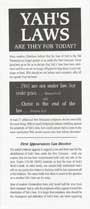
Many Christians1 believe the moral laws of God in the Old Testament are no longer pertinent under the New Covenant. Some preachers go so far as to declare that Yah's2 laws have been abolished and that we are no longer obligated to keep them. After all, the Apostle Paul proclaimed, "...[We] are not under law, but under grace...." (Romans 6:14)3 and "...Christ is the end of the law...." (Romans 10:4).
At least twenty-seven additional New Testament Scriptures contain similar declarations. With so much scriptural evidence testifying against the perpetuity of Yahweh's laws, how could anyone fail to come to the same conclusion? Why would anyone debate otherwise?
First Appearances Can Deceive
The initial evidence appears to support the dissolution of Yahweh's laws under the New Covenant. However, this evidence provides only one side of the story. Psalm 119:160 (NASB) instructs us that the sum of Yahweh's Word is truth. You cannot fully understand Yahweh's will on any doctrine until you have examined all Scripture pertaining to that doctrine.
Many of today's ministers present only the Scriptures that appear to suspend Yahweh's law. Unfortunately, these ministers (who should be champions and defenders of His law) remain silent about the greater number of passages that uphold God's moral laws under the New Covenant. These Scriptures include:
Circumcision is nothing, and uncircumcision is nothing, but the keeping of the commandments of God. (1 Corinthians 7:19)
...we know that the law is good, if a man use it lawfully. (1Timothy 1:8)
Thirty-five additional New Testament Scriptures testify to the perpetuity of God's triune moral law (His commandments, statutes, and judgments) under the New Covenant.
Faced With a Dilemma
Which are we to believe—the twenty-nine New Testament Scriptures that appear to say Yahweh's laws are not for today, or the thirty-seven New Testament Scriptures that declare His laws are still valid? If we begin with the premise that the Bible is inspired and does not contradict itself, then we must accept and integrate all sixty-six passages.
Those who promote the idea that God's law is no longer pertinent under the New Covenant dispensation often cite the Apostle Paul's epistle to the Galatians to "support" their position:
But before faith came, we were kept under the law, shut up unto the faith which should afterwards be revealed. Wherefore the law was our schoolmaster to bring us unto Christ, that we might be justified by faith. But after that faith is come, we are no longer under a schoolmaster. (Galatians 3:23-25)
Antinomian (anti-law) Christians are quick to announce, "See, the law is no longer valid today!" However, we have to ask, "Which law?" The Greek word nomos, from which the New Testament word "law" is translated, has a variety of New Testament applications:
- Any law whatsoever
- The law of Jesus4 Christ
- The entire Old Testament, including the Psalms, Proverbs, and the Prophets
- The first five books of the Old Testament (the Pentateuch)
- The Mosaic Covenant, including its sacrificial and ceremonial laws
- The moral laws of Yahweh, as found in His commandments, statutes, and judgments
Christians who teach Yahweh's law is no longer relevant usually choose some combination of 5 and 6. Seldom do they consider the other options because, in most instances, no one has taught them other options exist.
The Correct Choice
Do Galatians 3 and the twenty-nine other New Testament Scriptures teach that Yahweh's commandments, statutes, and judgments have been abolished? In Galatians 3:16-17, Paul identified the law that was annulled as the law that was added 430 years after the promises were given to Abraham. This means that only what was added at Mt. Sinai was abolished under the New Covenant. Any law in existence prior to the Mosaic Covenant cannot be the law Jesus repealed.
Prior Existence of Yah's Laws
Evidence of the existence of Yahweh's laws before Mt. Sinai can be found in several locations. For example, over 500 years prior to Moses, Abraham kept the same triune moral law later codified by Moses:
...Abraham obeyed my voice, and kept my charge, my commandments, my statutes, and my laws. (Genesis 26:5)
The book of Jasher5 verifies Abraham's observance of the law:
...Abram served the Lord his God all the days of his life, and he walked in His ways and followed His law. (Jasher 12:42)
Abraham reminded Isaac of Yahweh's instructions and, in so doing, identified the laws he and his pre-Mosaic posterity kept:
...He [Yahweh] said unto me [Abraham], to thy seed I will give all the lands, and they shall inherit them when they keep my commandments, statutes and my judgments that I have commanded thee [Isaac], and which I shall command them. (Jasher 26:24)
This structuring of Yahweh's moral law into three integral components—commandments, statutes, and judgments—is the same structure Moses later codified in the Pentateuch:
Now these are the commandments, the statutes, and the judgments, which YHWH6 your God commanded to teach you.... (Deuteronomy 6:1)
No written testimony of the commandments, statutes, and judgments exists in its entirety before Mt. Sinai, but they were nonetheless in existence. After all, they reflect Yahweh's nature and never-changing morality, as implicit in His everlasting righteousness (Psalm 119:142). They were verbally imparted from generation to generation, from Adam to Seth to Noah to Shem and on to their progeny.
The Apostle John defines sin as a transgression of Yahweh's law:
...whosoever committeth sin transgresseth also the law: for sin is the transgression of the law. (1 John 3:4)
With this truism in mind, Paul provided additional proof that Yahweh's moral law existed prior to Mt. Sinai. In Galatians 3:19, he declared that the law at Mt. Sinai was "added because of transgressions." The sins he alluded to were transgressions of Yahweh's commandments, statutes, and judgments during the period between Adam and Moses. Where there is no law, there can be no transgression; therefore, the moral laws of Yahweh had to exist before the exodus of the Israelites from Egypt. They could not have been the law that was added at Mt. Sinai. As a result, neither could they have been the added law Jesus abolished.7
The Added Law
If the commandments, statutes, and judgments were not the added law Paul alluded to in Galatians 3, then what law was he referring to? Hebrews 7:19-22 uses the words "covenant" and "law" interchangeably. A covenant is a law itself, only more comprehensive in its scope and application.
Galatians 3:19 refers to two different laws: one that existed before Mt. Sinai (the commandments, statutes, and judgments the Hebrews transgressed) and the Covenant (containing those same commandments, statutes, and judgments) that was added at Mt. Sinai. Verse 19 is correctly interpreted in the following fashion:
Wherefore then serveth the law [Mosaic Covenant]? It was added because of transgressions [of Yahweh's commandments, statutes, and judgments during the Abrahamic Covenant].... (Galatians 3:19)
Yahweh's commandments, statutes, and judgments were not the law added at Mt. Sinai, therefore they could not have been abolished under the New Covenant. The Mosaic Covenant was added at Mt. Sinai and was therefore the schoolmaster (mentioned in Galatians 3:24) that was abolished when Jesus sacrificed Himself in payment for our sins.
Many contemporary Christians believe the Old Covenant law was superseded by a higher New Covenant law. Although the New Covenant does supersede the Old Covenant (Hebrews 7:22, 8:6-7), it does not supersede the Old Covenant canon. The moral laws under both Covenants are the same. One covenant replaced the other, but the moral law of Yahweh transcends both covenants.
Compulsory vs. Voluntary Compliance
The chief difference between the Abrahamic and Mosaic Covenants was voluntary versus compulsory compliance. Paul wrote to the Galatian Christians that the law—the Mosaic Covenant—was added because of Israel's transgressions. The Israelites did not love Yahweh and their fellow man enough to freely comply with the moral law, which had been in existence from the beginning with Adam. As a result, Yahweh put them under compulsory compliance—"in custody" (Galatians 3:23 NASB)—by way of the Mosaic Covenant. Under that Covenant, the Israelites were compelled to keep His moral laws (and the added ceremonial and sacrificial ordinances) in order to be justified before Him. Moses offered the following explanation:
...it shall be our righteousness, if we observe to do all these commandments before YHWH our God, as he hath commanded us. (Deuteronomy 6:25)
It was this compulsory compliance for righteousness that Jesus abolished:
...Christ is the end of the law for righteousness to every one that believeth. (Romans 10:4)
Paul did not say that Jesus was the end of the law period, but rather that He was the end of the law (the Mosaic Covenant) for righteousness. Jesus was the end of the Mosaic Covenant, not Yahweh's commandments, statutes, and judgments. Contrast Deuteronomy 4:13 with Hebrews 8:8-10:
And he [Yahweh] declared unto you [Israel] his [Mosaic] covenant, which he commanded you to perform, even ten commandments; and he wrote them upon two tables of stone. (Deuteronomy 4:13)
...Behold, the days come, saith the Lord, when I will make a new covenant with the house of Israel and with the house of Judah.... For this is the covenant that I will make with the house of Israel after those days, saith the Lord; I will put my laws into their mind, and write them in their hearts.... (Hebrews 8:8-10)
Under the Mosaic Covenant, the Israelites were compelled to keep the commandments, statutes, and judgments, which had been written on stone. Under the Abrahamic and Christian Covenants (which are essentially the same), those same commandments, statutes, and judgments are written on our hearts and minds. We obey them voluntarily out of love for God and man.
Jesus' sacrifice and resurrection did not abolish Yahweh's moral law. Instead, it reestablished the law as He initially intended it to have been observed.
New Covenant Christians are now empowered by God's indwelling Spirit to do what was impossible under the Mosaic Covenant:
That the righteousness of the law might be fulfilled in us, who walk not after the flesh, but after the Spirit.... Because the carnal mind is enmity against God: for it is not subject to the law of God, neither indeed can be. So then they that are in the flesh cannot please God. But ye are not in the flesh, but in the Spirit, if so be that the Spirit of God dwell in you.... (Romans 8:4-9)
Because God's law is spiritual (Romans 7:14), we require the indwelling Spirit of God in order to keep it fully.
Although obedience is voluntary under the New Covenant, anyone who does not obey Yahweh's law is nevertheless carnal and at enmity with Him. Such a person does not love God, as demonstrated by his refusal to obey His law (John 14:15, 21; 1 John 5:2-3), the transgression of which constitutes sin
(1 John 3:4).
The Mosaic Covenant was added because of Israel's transgressions "til the seed should come." Jesus has come, thereby abolishing the Mosaic Covenant. He did not, however, abolish Yahweh's moral law. God forbid He would abolish what is perfect:
The law of YHWH is perfect, converting the soul: the testimony of YHWH is sure, making wise the simple. (Psalm 19:7)
Do we then make void the law through faith? God forbid: yea, we establish the law. (Romans 3:31)8
End Notes
1. Not everyone claiming to be a Christian has been properly instructed in Biblical salvation. Mark 16:15-16; Acts 2:36-41, 22:1-16; Romans 6:3-4; Galatians 3:26-27; Colossians 2:11-13; and 1 Peter 3:21 should be studied to understand what is required to be covered by the blood of Jesus and forgiven of your sins. For a more thorough explanation concerning baptism and its relationship to salvation, the book Baptism: All You Wanted to Know and More may be requested from Bible Law vs. The United States Constitution Ministries, PO Box 248, Scottsbluff, Nebraska 69363, for free.
2. Yah, found forty-eight times in the Hebrew Old Testament, is the abbreviated form of Yahweh, the principal Hebrew name of the God of the Bible. For a more thorough explanation concerning the sacred names of God (without resorting to unscriptural extremes), "The Third Commandment" may be read online, or the book Thou shalt not take the name of YHWH thy God in vain may be ordered from Bible Law vs. The United States Constitution Ministries, PO Box 248, Scottsbluff, Nebraska 69363, for a suggested $4 donation.*
3. All Scripture is quoted from the King James Version unless otherwise noted. Portions of Scripture have been omitted for brevity. If you have questions regarding a passage, please open your Bible and study the text to ensure it has been properly used.
4. Yeshua (Yah saves) is the English transliteration of our Savior's given Hebrew name, with which He introduced Himself to Paul in Acts 26:14-15. (Jesus is a second-generation English transliteration of Iesous, the Greek transliteration of the Hebrew Yeshua.) Because Yeshua is unfamiliar to most readers, I have chosen to use Jesus in this tract in order to remove what might otherwise be a stumbling block. For a more thorough explanation regarding the sacred names of God, "The Third Commandment" may be read online, or the book Thou shalt not take the name of YHWH thy God in vain may be ordered from Bible Law vs. The United States Constitution Ministries, PO Box 248, Scottsbluff, Nebraska, 69363, for a suggested $4 donation.*
5. Although Jasher is not a part of canonized Scripture, it is cited in Joshua 10:13 and 2 Samuel 1:18.
6. Where the Tetragrammaton (YHWH)—the four Hebrew characters representing the personal name of God—has been unlawfully rendered the LORD or GOD in English translations, I have taken the liberty to insert YHWH where appropriate. For a more thorough explanation concerning important reasons for using the sacred name of God, "The Third Commandment" may be read online, or the book Thou shalt not take the name of YHWH thy God in vain may be ordered from Bible Law vs. The United States Constitution Ministries, PO Box 248, Scottsbluff, Nebraska, 69363, for a suggested $4 donation.*
7. Additional evidence for the prior existence of Yahweh's laws can be found at the times of Adam, Enoch, and Noah - see Jasher 3, 34 and 35, and Genesis 4:9-10, 14; 7:2-3; 9:4-6, 23; 14:20; 18:19; 24:23; 28:22; 31:39; 34:7; 35:2-4; 38:8, 24; 39:9; and 42:22.
8. For a more thorough explanation concerning Yahweh's moral law as it applies today, Law and Kingdom: Their Relevance Under the New Covenant may be read online, or the book may be ordered from Bible Law vs. The United States Constitution Ministries, PO Box 248, Scottsbluff, Nebraska, 69363, for a suggested $4 donation.*
*We are admonished in Matthew 10:8, "Freely ye have received, freely give." Although we have a suggested a price for our books, we do not sell them. In keeping with 2 Corinthians 9:7, this ministry is supported by freewill offerings. If you cannot afford the suggested price, inform us of your situation, and we will be pleased to provide you whatever you need for whatever you can send.
|

 Printable version